


1 way to put your anchor aweigh, er, away
Jan 9, 2020
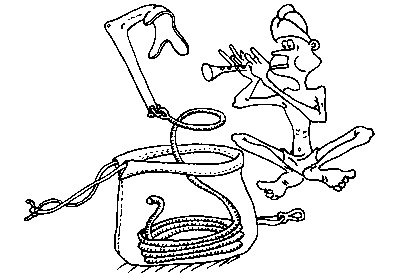
Here’s an easy-to-make project that solves two problems with your dinghy anchor (ours is a charming little Bruce) and rode. If yours is like ours, it migrates all over the floor of the dinghy (a soggy, sandy mess). Then it comes aboard the big boat (still a soggy, sandy mess). Yukkers.
This bag does more than hold your anchor and rode in one tidy little pile. After you’ve anchored you can dunk the whole thing – anchor, rode and bag – into the drink for a rinse, and then let it air dry before toting it back (in organized fashion) aboard the mother ship.
The secret ingredient is the vinyl-coated polyester mesh fabric. The most common brand is Texilene®. (You can buy it at Genco Marine in Toronto, or check with your local marine canvas dealer or at upholstery shops.) It’s even available in lots of colours: navy, blue, forest green, sand, white, grey…
1. To determine the size of your bag, make a tidy little pile of your dinghy anchor and rode on a flat surface.
2. Measure a piece of Texilene about 6″ to 8″ longer than your anchor, and about twice as high as the pile. (To check your dimensions, before you cut, fold the fabric up around the stack. You want a bag that’s easy to slip your anchor into and out of, yet small enough to be manageable. But we’re not creating high fashion, either, so approximate works.)
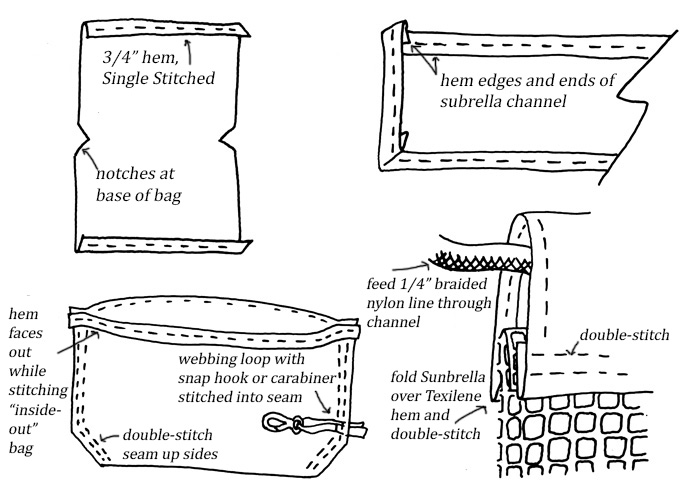
3. Notch the fabric at the midpoint, where the bottom corners will be. Fold the top edges down and single-stitch a 3⁄4″ hem. With the hems facing out, fold the fabric at the notches, creating the bag and double-stitch a 3⁄4″ seam* up the sides.
*Optional accessory: Add a brass snap hook or stainless carabiner to attach your bag to an eye or lifting point on your dinghy, to keep it from roaming, especially when the anchor is out and in use. Slip a 6″ piece of webbing through the eye of the hook or carabiner, then stitch the ends of the webbing (forming a loop) into the seam of your bag. (The bag is inside out at this point, so your loop should be on the inside.)
4. Now create the channel for the drawstring. Cut a strip of Sunbrella® or similar canvas material 61⁄2″ wide and twice the width of your Texilene bag. (Ask for a scrap from your marine canvas or upholstery shop where you get the Texilene.) Hem the edges and ends of the strip.
5. Turn the bag right side out, then fold the Sunbrella strip over the top rim of the bag creating a loose channel (roughly 2″, easy to slide a rope in) to hold the drawstring with a 3⁄4″ overlap on the Texilene, and double-stitch a seam all around. Leave an opening for the drawstring where the Sunbrella meets.