


Boat DIY: Cradle adjustments can distort your boat
July 7, 2022
By Marc Robic
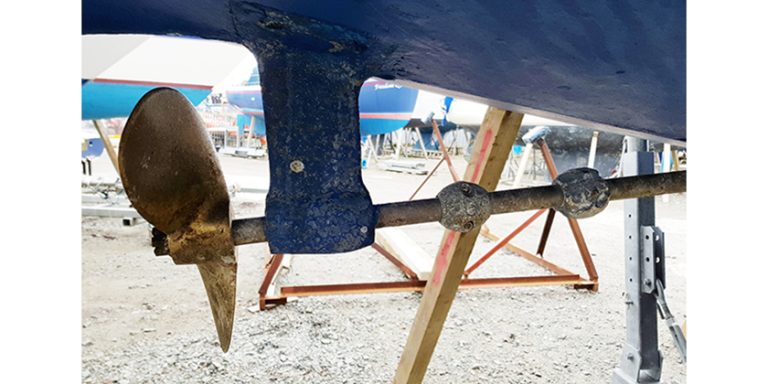
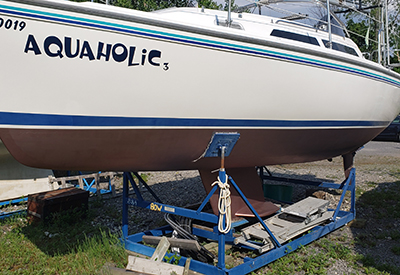
Boat on cradle adjustable pads visible and raised keel bed
Last issue of CYOB, we discussed stay and shroud tension and how these adjustments can affect boat stress and even jam cupboard doors.
Another important yet often overlooked adjustment is the cradle! I see many boats where all the weight is either on the keel or all on the pads. There is a proper load distribution for each boat. But as a guideline, I use the 70/30% rule. Meaning I try to put 70% of the weight on the keel and 30% on the pads. Of course, this is only a guesstimate. Each boat will be different.
But if on the cradle you notice a bulge on the cabin floor or the doors don’t open as easily as they should, chances are the boat is not sitting properly on the cradle. Too much weight on the keel alone, or perhaps too much weight on the pads.
How to adjust your cradle is simple and once you’ve done so, it will be easier the next time. Of course, if being hauled out with a crane, you will need to let the lead crewman know you want to adjust the keel spot and pad height set-up.
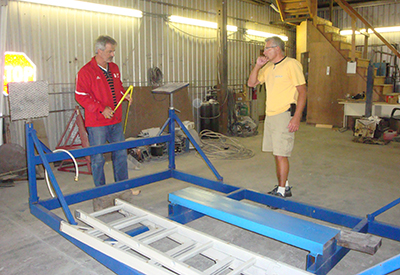 Cradle with raised keel bed and adjustable pads
This assumes your cradle pads are adjustable. If not, do yourself a huge favour and get a mobile welder to come and convert them. To do an even better job, increase the height of the keel bed. Doing so will provide much more flexibility to adjust your pads. In some cases, even the ability to lower them, one at a time, to prep and paint the anti-fouling paint under the pads. Also, once the boat is properly set on the cradle, mark the keel bed to identify where the keel sits at the next haul out. Another advantage of increasing the bed height, is easier access and less back breaking acrobatics when servicing and painting the hull.
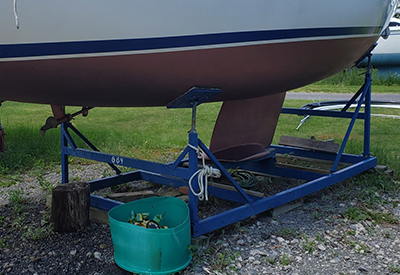 Another issue I see with cradles is no support under the keel bed. So, even with support pads on all four corners, approximately 70% of the weight still sits on the center bed. If not supported properly, it will slowly warp or bend downwards adding more weight onto the corner pads, possibly causing indentations in the hull where the pads sit. And this also can cause things like doors and cabinets to become misaligned or warped.
So, if you find your cabin or doors are not aligned, think twice before getting the sander or saw out. Remember to check when you haul this autumn!
 INFORMATION about the writer: Marc is a member of the Canadian Power & Sail Squadron. He and his wife sail their Catalina 270, Aquaholic 3, out of the Ile-Perrot Yacht Club in Montreal, where Marc spent 16 years as Harbour Master. They are regular Caribbean bareboat yacht charterers. With over 40-years experience, Marc is also an avid onboard do-it-yourselfer.
Marc Robic
mrobic@aol.com