


Ford Motor Company and Sharrow Engineering Scale Production of the Sharrow Propeller in Detroit
April 23, 2026
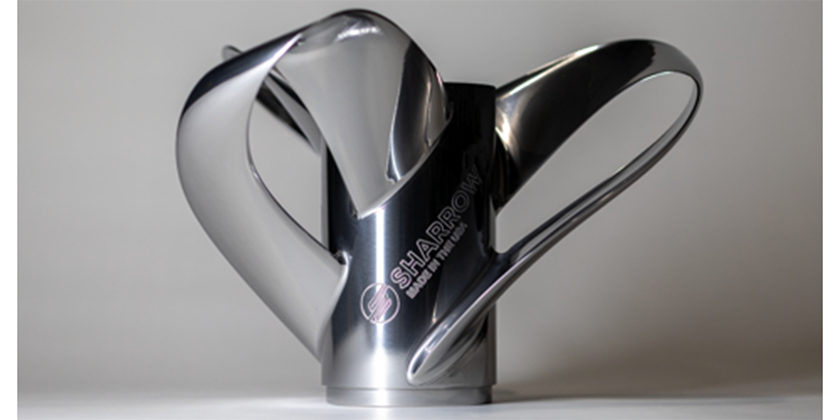
Sharrow Engineering just announced that it is scaling production of its patented Sharrow™ Propeller through a collaboration with Ford Motor Company’s Advanced Industrial Technology & Platforms (ATP) team, using advanced 3D sand-casting techniques thanks to connections made through the Michigan Central innovation ecosystem.
The result is a significant reduction in production timelines, shortening what used to take as much as 130 days with traditional investment casting to approximately two weeks, while maintaining the precision required for Sharrow’s designs.
Michigan Central – Detroit’s hub for mobility innovation, which brings together startups, industry leaders, and other partners to help advance next-generation technologies – facilitated the collaboration between Sharrow and Ford, connecting Sharrow’s proprietary propeller design with Ford’s expertise in manufacturing innovation and industrial scale.
Over the past nine months, the teams worked together to adapt Sharrow’s precision-engineered designs to a 3D-printed sand-casting process. The effort focused on refining and validating the casting process to enable high-volume production and help Sharrow meet growing consumer demand for the Sharrow Propeller.
“Michigan Central was built to bring together the people, infrastructure, and expertise needed to help companies move from breakthrough ideas to real-world scale. Sharrow is exactly the kind of company we’re here to support — an innovator with proven technology and growing demand,” said Carolina Pluszczynski, Acting CEO of Michigan Central. “It is incredible to see how Sharrow has scaled since joining our ecosystem. They have leveraged the prototyping labs here, found talent to grow their team, and expanded their footprint. And now, by connecting them with the Ford advanced manufacturing team, Sharrow has drastically accelerated its production processes, turning innovation into tangible impact.”
As part of the effort, Ford helped develop and refine the mold manufacturing process while working closely with experienced regional foundries to bring the new casting approach online. By combining Ford’s expertise in advanced manufacturing processes with the deep metallurgical and pouring experience of local foundry partners, the collaboration has accelerated the path toward scalable production of the Sharrow Propeller.
“Ford has been at the leading edge of 3D sand-casting for more than 20 years, and it’s rewarding to use that expertise to help another Michigan company scale so quickly,” says Dan Michalski, additive manufacturing operations supervisor, Ford. “This is about more than just propellers – it’s about making industrial innovation available to customers like Sharrow so they can compete on a global stage.”
Since its launch in 2020, the Sharrow™ Propeller has seen rapidly growing demand from recreational boaters, commercial operators, and government agencies seeking improvements in efficiency, noise reduction, and performance. The breakthrough design has also attracted interest beyond marine propulsion, with potential applications across mobility, defense, and energy systems. As demand for the technology has expanded, scaling production to meet global interest has become the company’s primary focus.
“Since we introduced the Sharrow Propeller, the market response has been extraordinary, but scaling production has been our biggest challenge, particularly getting high-quality castings fast enough to meet demand,” said Greg Sharrow, Founder and CEO of Sharrow Engineering and Sharrow Marine. “That’s one of the reasons we came to Detroit — to tap into a level of manufacturing capability and ecosystem we couldn’t find anywhere else, including the network at Michigan Central. This collaboration with Ford Motor Company has solved that problem for us in a big way. What used to take an entire boating season to produce can now be made in just a few weeks. That’s game-changing. It’s a powerful example of what can happen when companies like Ford help bring breakthrough technologies to industrial scale.”
This advancement builds on Sharrow’s continued investment in U.S.-based manufacturing, including its fourth expansion in five years to its new 60,000-square-foot facility in Harper Woods, Michigan, and supports ongoing hiring and growth in the Detroit region.
The collaboration also marks a broader step forward for Sharrow as the company expands beyond marine propulsion into new categories of mobility and energy efficiency. The same core technology behind the Sharrow Propeller has applications across drones, advanced air mobility, industrial fans, pumps, and renewable energy systems. With rapid prototyping at Michigan Central and Newlab Detroit, and Ford’s manufacturing expertise helping scale production, Sharrow now has a clear pathway to move new propulsion technologies from concept to industrial production faster than ever before.