


Personal Flotation Devices and Lifejackets – Do they work and should you wear them?
July 23, 2026
By John Gullick
The simple answer to both the questions above is yes but first some facts.
In October 2002 the Canadian Safe Boating Council contracted with SmartRisk, a national injury prevention organization, to develop a background research paper that would summarize the best available information pertinent to drowning related to recreational boating in Canada and the relationship to those drowning incidents and PFD/Lifejacket wear. This project was funded by the Cook-Reese Memorial Fund. The full 276 page report and related materials can be found on the CSBC web site www.csbc.ca All this material is downloadable. Most of the information for this article is taken directly from the summary of this report. Here are the facts:
Every year in Canada an average of 140 recreational boaters drown. However, it is suspected that this is an underestimate of the true number of drowning deaths by up to 43% due to misclassification of drownings. 65% of drowning victims were typically engaged in fishing and/or power boating in small open boats under 5.5 meters (18 ft) in length. 86% of these drownings occurred on inland lakes and rivers and 17% of drowning incidents involved multiple drowning victims, 3 per incident. 47% of drownings occurred after their boat capsized or swamped and another 20% of victims fell overboard.
Canada has a higher drowning rate per capita than the US, Scotland, France and the UK but boat ownership is known to be higher in Canada. The social and human cost of the loss of life in recreational boating drownings is incalculable. However, an economist has developed an economic burden model based on forgone market wages in 1999 and estimated that the economic burden is over $30 million annually. Other estimates that include the cost of search and rescue raise this annual figure to over $80 million.
Males, primarily age 25-45, account for 90% of all recreational boating drowning. Swimming ability is not a strong factor. Only 14% of those who drowned in 1999 were non or weak swimmers and operator inexperience was estimated to influence 40% of boating fatalities. Sudden cold water immersion was a significant influence. Or body’s natural “gasp reflex” kicks in during the first few seconds after unexpectedly entering old water. If the head is below water during the gasp there is very little hope of survival.
After the first three minutes when we are able to gain control over our body we have about 10 to 20 minutes to affect self rescue. This includes the time it takes to put on a PFD if there is one close at hand. 43% of drowning occurred within 10 meters (33 ft) of safety and an additional 25% occurred within 20 meters (65 ft) of safety. Alcohol continues to be a factor in drownings, about 40%.
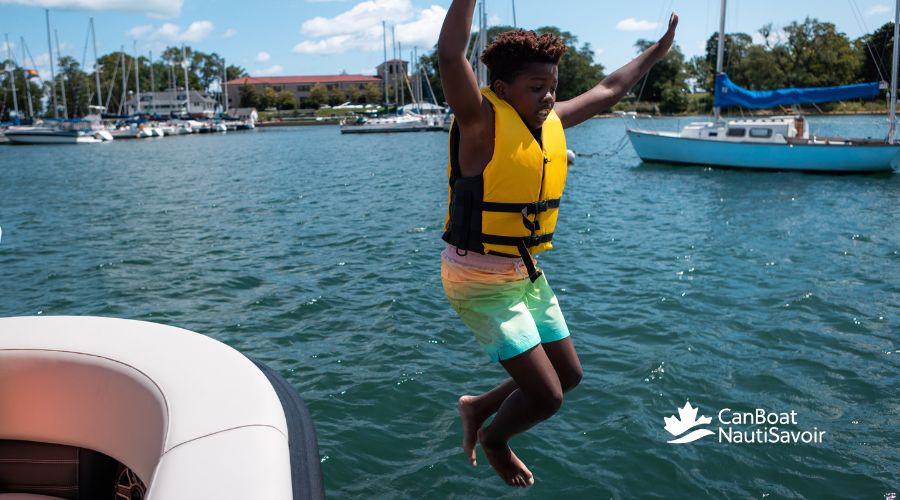
The most important and consistent risk factor in boating fatalities is the non use of flotation devices. 9 out of 10 drowning victims are not wearing PFDs and this proportion remains unchanged over the last 15 years. PFDs and lifejackets have enough buoyancy to keep most adults afloat and have at least some capability to turn the wearer onto his or her back.
Having time to locate, put on and buckle up a PFD in an emergency before ending up in the water is unrealistic. Most immersions are sudden. Marine police officers and boating TV personalities have challenged boaters with a reward to locate, don and fasten their PFDs within 30 seconds. Less than 5% were able to meet the challenge. Keeping a PFD nearby rather than wearing it is like trying to buckle a car seat belt just before a car crash.
There are now many types, colours and styles to choose from so get the one that best meets your needs. If you are operating a personal watercraft or high performance boat a high impact PFD is required. They have both a zipper and multiple straps with good chest/impact protection. If fishing is your thing consider a fishing vest style. There are also inflatables that work automatically, good for situations where you might be knocked overboard, and manually with the quick pull of a cord. These must be worn at all times when on deck to be considered legal and cannot be worn by anyone under 16 years of age. Automatic inflatables cannot be used on a Personal Watercraft, white water paddling or sailboarding and should not be used for any other types of boating where you are likely to get wet on a regular basis. For paddling or small dingy sailing a vest that is inherently buoyant (does not have to be inflated) is advisable. There are a number of purpose designed PFDs that are light and comfortable, allow for ease and a full range of arm movement, do not press down on the shoulders and have good flotation and protection.
Here is the bottom line. PFDs and lifejackets only work if you are wearing them. If you find yourself in any situation on deck where you or your passengers could fall overboard for any reason put on your PFD.
Be safe, be sure for you, your family and friends. Make every trip a fun return trip. To coin an old phrase with some new meaning, “Buckle Up”
By John Gullick, currently CanBoat’s Manager of Government and Special Programs and has been an active recreational marine specialist and writer for over 50 years.
Sign up for the CanBoat newsletter and visit CanBoat.ca to learn more about us.