


Lifejackets and Personal Flotation Devices (PFDs) and the Law
May 28, 2026
By John Gullick
In about 85% of drowning deaths related to recreational boating, a PFD or lifejacket was not being worn and in many cases, there were none onboard the vessel. 45% of these incidents occur within 15 meters of safety and even more within 25 meters of safety. That means that if a person finds themselves unexpectedly in the water and was wearing a PFD or lifejacket, they would have a good chance of initiating self-rescue or staying afloat and being seen when help arrives.
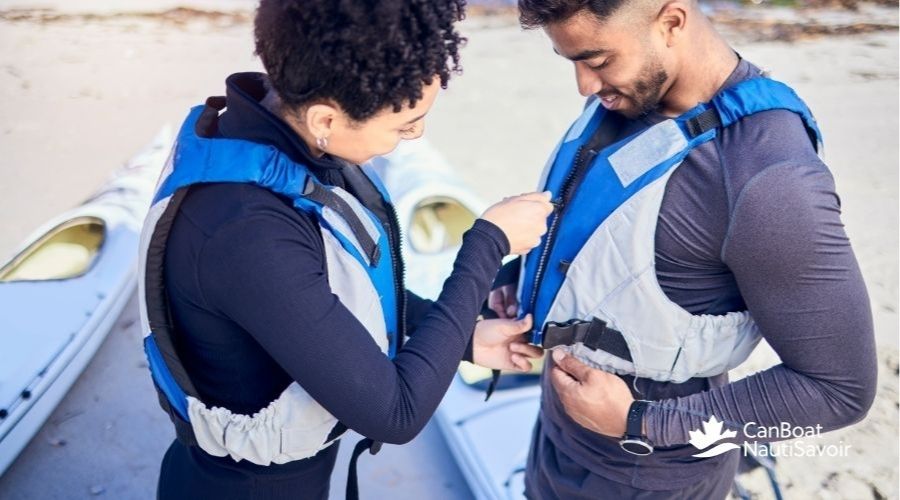
PFDs come in various styles suited to specific types of boating, so choose one that best meets your boating needs and one that you will wear while on the water and underway. PFDs also come in various colours so, again, choose ones that will help encourage you and your family to wear.
For care and maintenance, follow the manufacturer’s instructions that are attached to each new PFD. You can also go online to find those instructions.
PFDs and lifejackets do not work if you are not wearing them.
Some rules:
- There must be a Personal Flotation Device (PFD) or lifejacket of an appropriate size and in good working condition for each person on board any pleasure craft, powered or non-powered. This would include crafts like paddle boats and paddle boards.
- All PFDs or lifejackets must be approved by the Canadian Coast Guard, Transport Canada, the Department of Fisheries and Oceans or any combination of the above. This approval label must be permanently attached or printed on every PFD or lifejacket. We now begin to find PFDs and lifejackets that are approved for use in North America, but his will be noted on the attached label.
- When the vessel is under way, all PFDs and lifejackets must be “readily accessible” which means capable of being reached easily and safely under emergency conditions. Don’t keep them stored in a locker when under way. Have them close at hand.
- PFDs and lifejackets cannot be altered in a way that compromises its original structural integrity or diminishes the integrity or readability of its approval label. If a PFD or
- Lifejacket is badly faded or requires any sort of repair; it must be rendered unusable by others, discarded and replaced.
- A PFD or lifejacket that is required by the Small Vessel Regulations does not have to be an appropriate size for an infant who weighs less than 9 kg (20 lbs) or a person whose chest size is more than 140 cm (55 in).
- A PFD or lifejacket that is required by the Small Vessel Regulations may be of an inflatable type only if it is worn at all times when underway.
- in the case of an open vessel, by every person on board; and
- in the case of a vessel that is not open, by every person on deck or in the cockpit.
- If a PFD or lifejacket that must be carried on board a pleasure craft is to be worn by a person less than 16 years of age or weighing less than 36.3 kg (80 lbs), it shall be inherently buoyant. They cannot use an inflatable PFD.
- Inflatable PFDs cannot be used for white water paddling and operating a personal watercraft.
- A PFD or lifejacket that is required by the Small Vessel Regulations to be carried on board a personal watercraft shall be inherently buoyant. This means that it contains the required amount of floatation material without having to be inflated.
- Lifesaving cushions are not approved as safety equipment on any boat.
Most of the points above are direct quotes regarding Personal Flotation Devices (PFD) or lifejackets taken from the Canadian Small Vessel Regulations.
Fines for not having an approved PFD or lifejacket of the appropriate size and in good working condition can be well in excess of $250 per person.
Transport Canada’s Safe Boating Guide, which is available on-line, clearly states: “A PFD or lifejacket is the best insurance you can have. So, find one that suits your needs and wear it.”
To learn more or sign up for our newsletter go to: CANBOAT.CA
By John Gullick, currently CanBoat’s Manager of Government and Special Programs and has been an active recreational marine specialist and writer for over 50 years.