

The Rules Guy: An overview of the right-of-way rules II

April 9, 2020
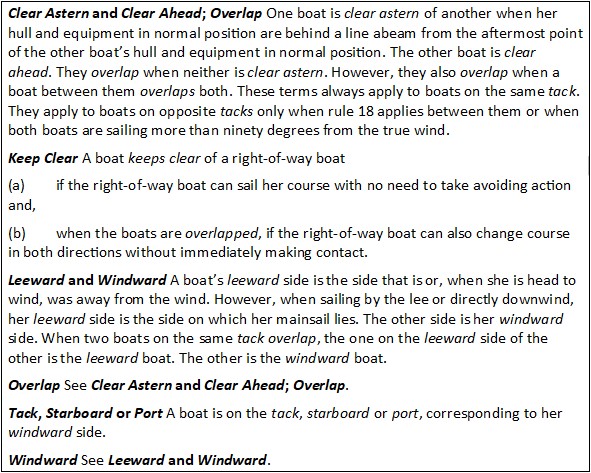
Last column we started an overview of the right-of-way rules. That issue focused on Section A of Part 2. At the end of that article, I said would next focus on the definitions. Early in the Rules book, there is a separate section helpfully titled “Definitions”. Many of the words in the book sail under the colours of the standard definitions provided by a good dictionary, and that is what we use if a word is not defined in the rulebook. Some words, though, need a very specific definition and we find those here. If a word is in italics in a rule, then it is defined in the rulebook’s definitions; its meaning and its role in the rules that use it is specifically tied to the definition listed there. Note, for instance, the way the conventional concepts of “Clear Astern” and “Clear Ahead” are modified for racing by the boats’ respective tacks.
I have included with this article the definitions that apply to the rules we discussed in the last article. They are probably, along with the definitions of Room and Mark-Room, the most important definitions for the right-of-way rules. Rule 10 starts off by telling us that port-tack boats have to keep clear of starboard-tack boats. To use this rule, we first need to understand the meaning of “Port Tack” and “Starboard Tack” and then what it means to “Keep Clear”. In many circumstances, it is obvious who is on Port Tack and who is on Starboard Tack. In some cases, there might be some debate.
In the diagram, Blue is clearly on starboard tack. The wind is coming over her starboard side and her boom is on her port side. Yellow is just as clearly on port tack. What about Green? Which side is her windward side? The wind is coming over her port side, but her boom is on her port side as well. The definition of Tack doesn’t help much, as it just says that her tack corresponds to her windward side. We have to look at the definition of Windward and Leeward, which says, “However, when sailing by the lee or directly downwind, her leeward side is the side on which her mainsail lies.” In this case, Green is sailing by the lee, so her leeward side is the side on which her mainsail lies and the windward side is the opposite side, so Green is on starboard tack. By the same definitions, Red is on port tack.
The other defined term in rule 10 is “Keep Clear”. According to the definition, the give-way boat is keeping clear if the right-of-way can sail her course without taking avoiding action. In the diagram, Green has to take avoiding action, so Red is not keeping clear. Blue is probably far enough away from Yellow that she is still keeping clear, but she will have to do something very soon or Yellow will have to take avoiding action and then Blue will not be keeping clear.
 We can use the other definitions in similar ways to help interpret rules 11-13. Often overlooked, definitions are a foundation to understanding the rules.
Andrew Alberti is an International Judge and National Umpire. He is a member of the Sail Canada Rules and Appeals Committees. Send your questions to Andrew at kyrules@alberti.ca.