


Ocean changes unsettling to solo sailor
 A Canadian sailing in a solo around-the-world race says he is disturbed by the "horrendous" conditions he has encountered in the southern oceans — including the near absence of large sea life.
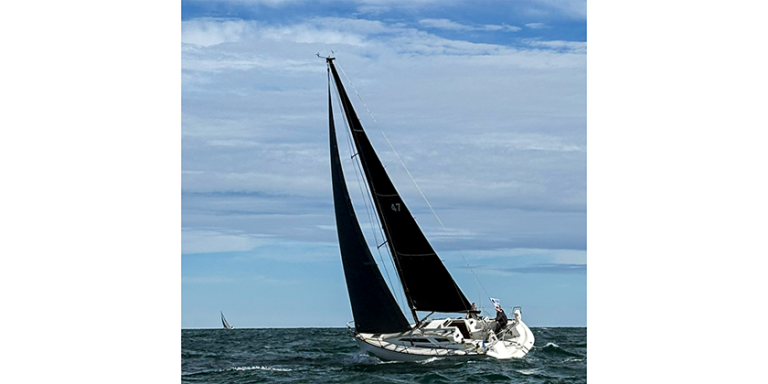
Derek Hatfield has rounded the planet alone twice before but this trip through the southern ocean has been a relentless stream of extreme storms and deepest calms.
"The conditions are — to put it bluntly — horrendous," adds Hatfield.
Much of that can be attributed to an extreme year for La Nina, a weather event where the Pacific Ocean cools in the east and warms in the west. This gives rise to dramatic changes in weather patterns and to events like the destructive flooding seen in Australia this year.
Compounding this may be the fact that the Earth's oceans on average have warmed by half a degree over the last decade, says Australian meteorologist Roger (Clouds) Badham.
"Can we say that this event is a little bit more intense than what it would have been otherwise?" asks Badham. "It's very hard to say but you'd probably start to say, yes it is."
Absence of sea life
Hatfield's most disquieting observation so far has been the almost complete absence of sea life.
He says he saw just one dolphin in the second leg of the Velux 5 Oceans race between Cape Town, South Africa, and Wellington, New Zealand.
"The lack of sea life is just horrendous, how it's changed in the last 10 years, going from daily visits from whales and dolphins to non-existent," laments Hatfield.
Dr. Daniel Pauly of the University of British Columbia's Fisheries Centre confirms that what Hatfield is seeing — or rather, isn't seeing — is in keeping with anecdotal evidence he has heard about the Southern Ocean.
"There are accumulating accounts of no marine life," he says.
But Dr. Hal Whitehead, a whale specialist at Dalhousie University in Halifax, believes it may just be that Hatfield was in the wrong place at the wrong time.
"My guess is that the whales and dolphins of the Southern Ocean are heavily clustered in particular locations at particular times (for instance, at the Antarctic Convergence), and that if you are not at the right place you miss them," Whitehead wrote in an email to the CBC.
Hatfield begins the third leg of the Velux 5 Oceans on Feb. 6. That part of the race leaves from Wellington, New Zealand, goes around Cape Horn at the southern tip of South America and ends in Punta del Este, Uruguay.