


Yanmar Develops Maritime Hydrogen Fuel Cell System
Feb 10, 2022
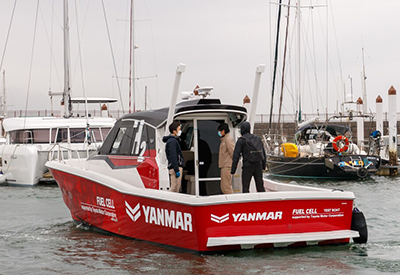
Yanmar test boat
Recent years have seen increasing efforts, all over the world, to reduce greenhouse gas (GHG) emissions towards the realization of a carbon neutral society. 123 countries and one region including Japan have already announced the goal of achieving net zero GHG emissions by 2050, and policies to reduce use of fossil fuels are being formulated around the world towards achieving this goal. At the same time, hydrogen is attracting worldwide attention as a clean energy source that can replace fossil fuels.
Yanmar has developed a fuel cell technology that uses hydrogen to produce electricity towards the realization of a carbon neutral society. Behind the scenes, there was a lot of collaboration not only inside the Yanmar Group, but also with the government, local authorities, and private corporations representing related industries.
The components of the powertrain for propulsion are quite different from the conventional diesel engine-powered boats which are designed in matured and standardized processes. In the case of the fuel cell demonstration boat, there were many components that had to be installed and work together such as fuel cell systems, motors, inverters, power distribution boxes, battery packs and hydrogen tanks etc.
Completion of the demonstration test boat
With the support of many partners, the efforts of project team bore fruit and construction of the futuristic looking demonstration test boat was completed successfully. The boat received approval from JCI and demonstration tests commenced in March 2021.
Yukihiko Kimura of the Marine Group, Solution Development Division notes “My colleagues said: ‘It was amazing that a 38-foot boat could run at over 20 knots with an electric motor’. Of course, there is no smell of diesel oil, or smoke, and it’s very quiet. Also, the acceleration is quite good compared to diesel engine-powered boats due to the features of the electric motor. I think that people who ride on the boat will appreciate it for its comfortable ride.
“The demonstration boat is so quiet that we can hear the natural sounds of the ocean. It’s something you can’t experience when you’re on a diesel engine-powered boat. From a boat building, navigation and service perspective, since the boat contains many components that are not installed in diesel engine-powered boats, and the actual weight of the boat is heavier, we need to start thinking about how we can make the fuel cell systems and components lighter and more compact.”