


Night-time Boating Tips
June 11, 2026
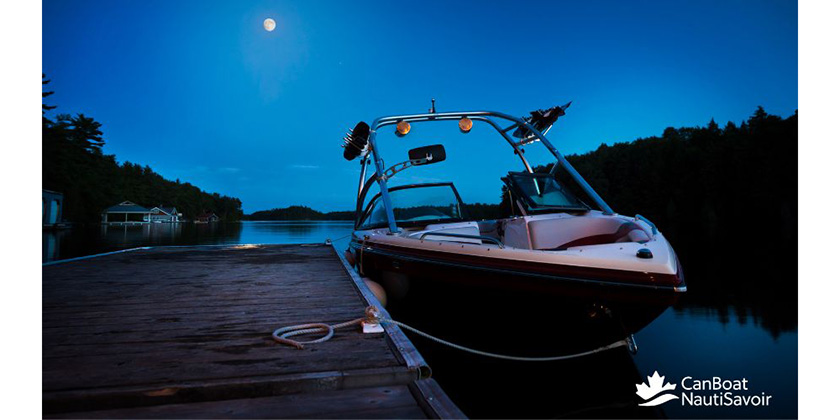
Unfortunately, we too often hear about boating accidents that occur at night. Many of these incidents take place after groups of boaters have gathered together to enjoy something like an evening lakeside concert or fireworks display. Often these events start during evening daylight hours and finish up well after dark. Boaters and their friends and families have arrived when it is easy to see what is going on around them and where they are in relation to other boaters and their immediate surroundings. When it becomes dark, often very dark, you can no longer make out points of reference, aids to navigation and even other boats. Sometimes you might have forgotten to check your navigation lights before you set out and now, when you actually need them, they are not working properly. Other boats are moving about in close proximity and they might not be able to see you or you them.
After the event is over it is a very good idea to wait for a short period of time, say 15 minutes, for the crowd of boats to dissipate. This will help to make your return trip a much less congested one and, hopefully, more enjoyable.
Sometimes a single boat will stop to watch stars in the night sky. They will turn off their navigation lights to better see the night sky. Without any lights it will be very difficult for other boaters to see them. Regulations require that an all-round white anchoring light be on in this situation and it is very important to maintain a continuous lookout and continually be aware of other boats operating in the area.
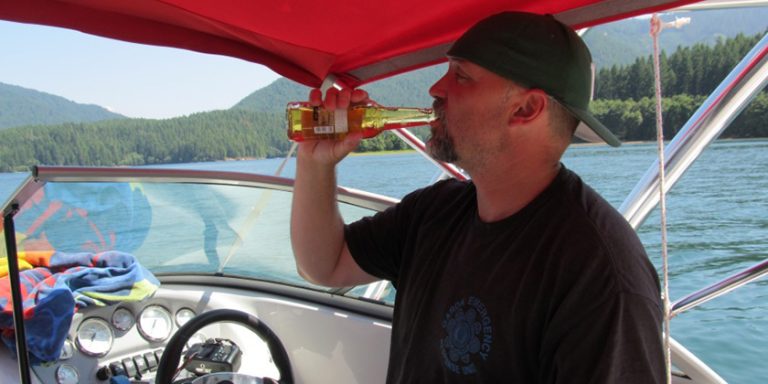
Speed and alcohol and/or recreational drugs may also be playing a role here. While anchored watching a show or fishing you may be tempted to have an alcoholic drink or two and afterwards another temptation is to try to get to your next destination too quickly.
When travelling at night, or even during the daytime, make sure you are traveling at a safe speed that will allow you to react quickly if the need arises.
At night the time that you will need to react will be much greater. Pay attention to posted speed limits and stay within them as required by regulation. You are responsible for any damage or harm that you cause. Ontario, and some other provinces, have adopted speed limits of 10 kilometers/hr. within 30 meters (100 ft) of shore within their boundaries.
Let’s step back a bit and consider this. As with any boating trip, day or night, pre-planning and having the required and right equipment in good working order is the key to success and enjoyment.
Consider where you are going and how you are going to get back. Check your up-to-date charts, note any potential hazards and any potential aids to navigation, especially those that will be clearly visible at night. At night, all lights often look the same so try to find ways of identifying which is which. As the sun goes down and lights come on, look around and make notes of clear points of reference.
Also, alert yourself to which way other boats are traveling depending on what navigation lights you can see. Remember who has right of way, is the Stand On Vessel, but again more importantly, always keep a constant lookout and don’t presume that others will know who is the Stand On Vessel, that they will be traveling at a safe speed, or that they will be maintaining a lookout.
At night, travel at a slower speed that reflects the actual conditions. Often on a clear night with a full moon visibility is quite good, but incoming cloud cover can end that very quickly.
Try to look over your windshield that will be acting as a light reflector. Distances will be hard to judge at night, and another boat that seems far away might in fact be quite close and moving towards you.
Make sure all your electronic equipment and navigation lights are working properly before setting out. Check all safety equipment, make sure that everyone has a properly fitting lifejacket or Personal Flotation Device (PFD) and that they are all in good condition. Better still, make sure everyone is wearing their PFDs and let everyone on board know where all the safety equipment is located and how to use it. Check the batteries in your flashlight and keep your charts close at hand.
If you are using inflatable PFDs, remember that by law they must be worn, and those wearing them must be at least 16 years of age.
Make sure you have enough gas to get to your destination and back home with some to spare. The rule of thumb is 1/3rd to get there, 1/3rd to get back and 1/3rd in reserve. It is also a good idea to let someone on land whom you trust know where you are going and when you expect to return.
All of these suggestions hold true for travel day or night, but extra care is required at night due to the more limited visibility and the fact that, at night, it becomes more difficult to know exactly where you are and to maintain your sense of direction.
Day or night it is a criminal offence to operate a vessel in a dangerous manner for example:
- Making sharp turns or S curves in one place.
- Jumping waves or wakes of other boats and coming closer to them than is reasonable.
- Producing unusual or excessive noise.
- Weaving through heavy traffic without reducing speed accordingly.
- Operating a boat at a speed greater than that required to maintain steering when close to swimmers or non-motorized boats.
- Waiting until the last minute to avoid a collision and making a sharp turn.
- Fail to stop at the scene of an accident.
- Tie up to a navigation aid, including buoys.
- Operate a vessel while disqualified/ prohibited.
In closing, I will again say wear your PFDs or lifejackets. They don’t work if you are not wearing them and if a problem arises it may be too late to grab a PFD, let alone be able to put it on.
To learn more or refresh your understanding of sound signals, navigation lights, and collision-avoidance rules, take CanBoat’s mini-course on Collision Avoidance Rules. Learn more HERE.
By John Gullick, currently CanBoat’s Manager of Government and Special Programs and has been an active recreational marine specialist and writer for over 50 years.
Sign up for the CanBoat newsletter and visit CanBoat.ca to learn more about us.