


Waterspouts: What are they? When can they occur? What should you do if you encounter one while boating.
July 12, 2023
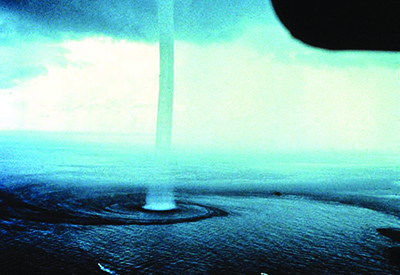
There are two types of waterspouts depending on their origin. The tornado type (the most intense) results when a tornado moves out over the water. This waterspout has all the characteristics of a true tornado. In contrast, the simpler and weaker convective type of waterspout (winds less than 56 kn) may occur in fair or foul weather and may rotate in either direction — tornadoes almost always rotate counterclockwise in the Northern Hemisphere.
Often seen on the Great Lakes and even farther north, waterspouts are frequent over the Florida Keys, the Gulf Coast and the New England Coast. Waterspouts are associated with rapidly growing cumulus clouds that have not become thunderstorms and often never become thunderstorms, often when the water temperature is warmer than the surrounding air. Landspouts are similar to waterspouts and have similar origins.
There are five stages in their development:
• 1st — formation of a dark spot on the ocean (air moving in a circle and upward)
• 2nd — spot begins to take on a spiral pattern of dark and lighter water (boater might feel a wind shift and/or speed increase; and might see a funnel coming from a cloud or off to one side)
• 3rd — boater sees spray vortex (winds of 35 knots begin to kick up spray in a circular pattern which means a vortex is reaching the ocean from the cloud). The boater might see a funnel pointing down from the cloud
• 4th — mature stage — funnel of tiny water droplets (thin cloud) reaches completely from the cloud to the surface of the ocean; small waves are being kicked up and a wake of effervescent bubbles caused by low air pressure is left behind
• 5th — spray vortex weakens, funnel distorts and waterspout dissipates as cool air from rain cuts off supply of warm humid air
The average duration of a waterspout is shorter than an average tornado and is measured in minutes. They tend to originate in warm air, over warm water, with light winds and high relative humidity.
Although typically weaker than tornadoes, they are dangerous. A boater should try to escape by going at right angles to its path away from it. Do not try to outrun it! Waterspouts commonly travel at 30 to 35 knots, and have been observed traveling at over 60 knots.
Get additional advice from our volunteers, watch The Weather Network video here.
To learn more about weather and forecasting register for our Weather for Boaters course at: www.boatingcourses.ca