


Sarah Douglas: a Roller Coaster ride to Tokyo
Story by John Morris
Photos by Helly Hansen
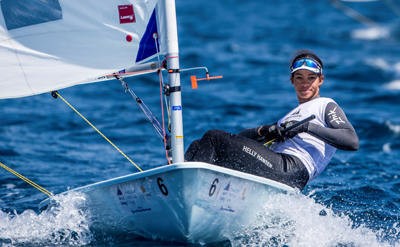
Sarah Douglas has developed into a skilled and focused competitor for the Canadian Sailing Team.
This February, Sarah Douglas, Canadian Olympic Team member in the Laser Radial class, won the Laser East Midwinters in Key Biscayne Florida. In the fleet of 89 boats, Sarah scored four bullets and her drop was a 4. Sounds simple enough – she’s a pretty fine sailor and should do well at the Olympics in Tokyo. Not so fast.
Let’s take a look at the daunting list that it is taking for Sarah Douglas to: 1) get to this level of excellence, 2) get to the starting line in Tokyo. To say the least, this has been a complicated journey with a lot of speed bumps. The normal complications and stresses of an international level sailing campaign have been multiplied to staggering levels by Olympic postponements, plus unpredictable, never-before hurdles due to COVID19.
Winter is cold in Canada – we know that. Earlier this year, with paperwork and meticulous documentation in hand Sarah headed to Florida with her boat in tow to do some work with her training partner, top-tier US Olympian Paige Railey, then compete in those Midwinters, which she eventually won. At the border, she was turned back as non-essential. On to Plan B – shipping her boat and car and flying south, which cost a fortune and created a lot of unexpected headaches. Getting the coaching boat to the regatta involved almost losing a trailer wheel, plus a second flat tire incident.
These comparatively minor blips are on top of last year’s complete change of plans when Canada’s Olympic Committee was among the first to pull out of the original Tokyo 2020 event. A total re-tooling was required when the Games were postponed by a year with an on-again-off-again cloud looming during the dozen intervening months.
Training in the winter against the world’s best, who will have to be beaten if a medal is on the agenda, requires traveling. Traveling during COVID19 requires intricate flight logistics, plus risk mitigation followed by lengthy quarantines each trip.
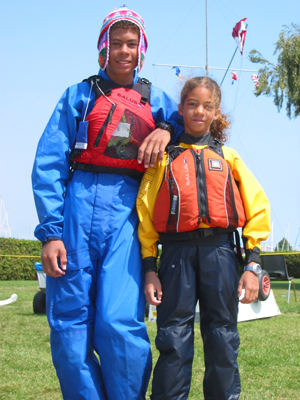 Sarah and her brother Greg Douglas who is a two-time Olympian in sailing.
The work is paying off
Currently, the goal is in sight. Sarah is in Portugal competing against the tough Europeans and readying herself for the biggest stage of her competitive career.
If there’s a sailor who can do this, Sarah has earned the right to try. Born in Burlington, ON, Sarah grew up in Barbados where she started sailing at 7. She flipped back to Canada for school with her brother Greg (Greg Douglas is a two-time Olympian in sailing who represented Barbados at Beijing 2008 and Canada at London 2012.) A young Sarah won the Canadian Optimist Championship in 2007 then moved up the ranks and continued to train. In 2010, an opportunity was presented to qualify Canada and represent the country at the inaugural Youth Olympic Games in Singapore.
For a few years Sarah lost her love of competing, but got re-inspired in 2014. In 2015, she volunteered at the Toronto Pan Am games (raking the Beach volleyball court), which she feels contributed significantly to her understanding of top tier events. At the 2018 Sailing World Championships in Aarhus, Denmark her sixth-place finish qualified Canada for an Olympic Laser Radial berth for Tokyo 2020. In the meantime, she graduated from the University of Guelph with a BComm in Marketing Management. Then, leaping from volunteer to competitor, Sarah won a gold medal at the 2019 Pan Am Games in Lima, Peru despite a bacterial infection that kept her mostly in bed when she wasn’t racing. Shortly thereafter, she followed up with a seventh-place finish at the official Olympic test event for Tokyo 2020.
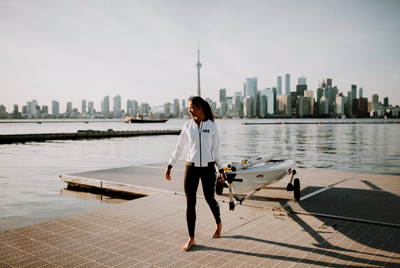 Sarah with her Laser Radial in Toronto
The preparation – a closer look
You probably never thought otherwise, but talking to Sarah you learn that getting to the Olympic podium is an endless schedule of hard work, much of it not particularly glamorous. Sarah and her coaches take an holistic approach combining competition, conditioning and mindset to achieve winning conditions.
Competition is self-explanatory – eating bad air in the back of the fleet for years then fighting to match the top tier, especially from beyond North America, is humbling but necessary.
Conditioning is a matter of hard work; sailing and hiking for long periods needs to become easy so the sailor can concentrate on wind shifts, strategy and the competition. You can’t achieve top-three dominance for ten straight races in a 90-boat Midwinters fleet as Sarah did this winter, without putting in a lot of work. This is a particular tribute to Sarah who has had to work though being diagnosed at age 14 with the genetic blood disorder Alpha-thalassemia, which reduces the amount of hemoglobin her body can produce. Having less oxygen carried throughout her body could put her at a competitive disadvantage, but she works hard in the gym to ensure that her endurance level is up to gold medal standard.
This will be particularly important in Tokyo where the heat is intense and dehydration is a perpetual hazard. When the Canadian team sailed in Japan previously, members were issued ice-vests to mitigate the unbearable heat.
That brings us to mind and attitude, the factors that separate the winners from the pack. “The credo of ‘let’s not complain, let’s not make excuses, embrace the pain’ has helped me make the big jump,” Sarah explains, noting this is an ongoing process supported by the Team sports psychologist and her coaches.
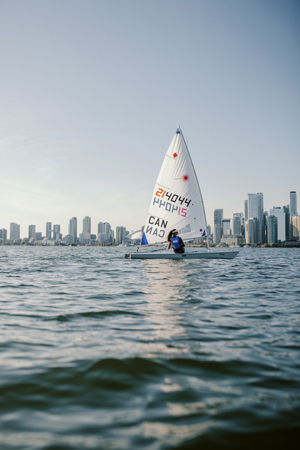 After a day sailing…to compete at these levels, Sarah needs to be on the water as much as possible and that is very expensive for a Canadian training for the Olympics. Photo Credit: Helly Hansen
Outlook for Japan
Sarah plans to win, then to use that experience to “lead by example” and grow the sport in Canada. Canada’s Olympians have all dedicated years and years of intense preparation to getting to Tokyo. For Sarah, who was Rolex Sailor of the Year in 2019, it is both a beginning as well as a goal in itself.
Will she plan for Paris 2024? “I am not even close to being done. The Olympics is big and tough, but a bronze is not good enough. I want to be dominant.”
In this country our sailing Olympians often are neglected compared to those competing in other sports. The Canadian team has had an uphill battle and when, as we hope and expect, Sarah puts on her medal this July, we Canadians should deliver the broad appreciation that she has worked for.
Epilogue
Sarah Douglas is one of nine members of the Canadian Sailing team. To learn about the other members and news about the team, click here: