

POTW: Lifting Boats at E Crate Marine
November 19, 2026
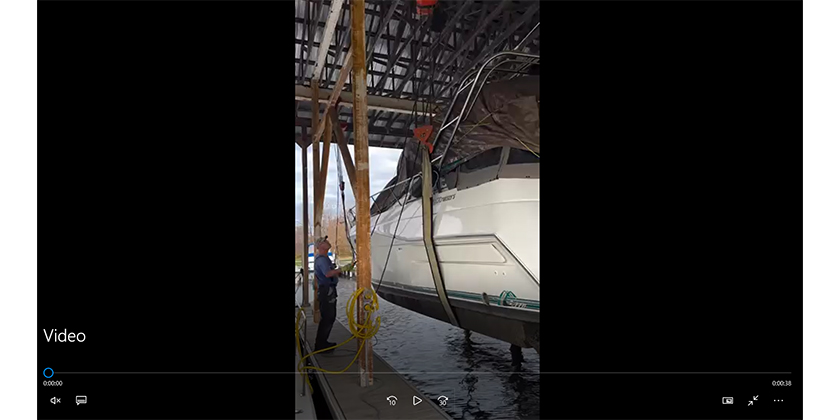
Our POTW Video of the Week comes from Pfefferlaw on Lake Simcoe where Emily Crate and her crew lift a lot of boats each fall as the lake freezes up.
The video tells the story and Emily has explained in detail how the process works:
At E Crate Marine Sales & Service, lifting and securing vessels inside our covered boathouse is a carefully coordinated operation requiring experience, precision, and teamwork. Every vessel is different, and our crew follows an established process under the supervision of a designated foreman to ensure the safety of our personnel, equipment, and customers’ boats.
Equipment
Our larger boathouse is equipped with four electrically operated 5-ton chain blocks and heavy-duty lifting slings rated for 33,000 pounds each.
Positioning the Lifting Slings
Our crew positions themselves along both sides of the dock and at the bow to maintain control of the vessel.
The stern and bow lifting slings are passed beneath the hull, carefully positioned at the appropriate lifting locations, and connected to the electric chain blocks.
Sling placement is especially important, as it varies depending on the vessel’s hull configuration and propulsion system. Particular attention is given to protecting sterndrives, propeller shafts, struts, and other underwater components.
Where necessary, 5/8 braided nylon lines are used between sling assemblies to help maintain their positioning.
Lifting the Vessel
We begin by gradually applying tension to the stern sling, followed by the bow, verifying proper alignment before raising the vessel.
Using the electric chain blocks, the crew carefully lifts the boat high enough to accommodate the supporting timbers.
Throughout the lift, our foreman monitors sling positioning, vessel balance, equipment operation, and crew safety.
Installing the Douglas Fir Timbers
Our crew positions substantial Douglas fir timbers beneath the suspended vessel.
These timbers measure approximately 18–20 feet long and weigh 200–250 pounds each, requiring considerable physical effort and coordination.
For an average 35–45-foot vessel, approximately 10–14 timbers may be used, depending on its hull configuration and support requirements.
Timbers are arranged in groups of three or four across designated support sections, providing a foundation for the blocking system.
Establishing Keel Support & Drainage
Before transferring the vessel’s weight, we determine the appropriate drainage angle based on its design.
Most recreational powerboats drain toward the stern and require a slightly elevated bow. Certain older models may have different drainage configurations.
We gradually lower the vessel onto prepared keel blocking, using structural lumber and plywood to establish firm, stable contact at the designated support points.
The crew carefully adjusts the blocking and vessel alignment throughout this process.
Installing Chine Supports & Distributing Weight
Once the keel supports are established, we install additional blocking beneath the designated outer hull or chine support areas.
Using substantial 8 × 8 timber blocks, structural lumber, plywood, and appropriately fitted shims, we create stable lateral supports.
Our traditional blocking arrangement aims to distribute approximately 60% of the vessel’s weight through the keel and 40% through the outer chine supports.
This distribution is adjusted as necessary according to the vessel’s construction, manufacturer recommendations, and approved support requirements.
Lowering & Securing the Vessel
With the blocking in place, the crew gradually lowers the vessel, transferring its weight from the lifting slings onto the keel and chine supports.
Our foreman continuously checks for proper weight distribution, alignment, secure contact, and any unexpected movement.
Once the vessel is fully supported and confirmed stable, the lifting slings are relieved of tension and carefully removed.
Final Inspection & Equipment Reset
Before completing the operation, our foreman performs a final inspection to verify:
Stability and proper positioning of all blocking.Appropriate keel and chine support.
Correct drainage angle.
Adequate clearance around underwater components.
Safe removal of all lifting equipment.
The electric chain blocks and slings are then repositioned for the next vessel.
Safety, Experience & Precision
Lifting a vessel inside a boathouse involves far more than simply raising it out of the water. It requires an experienced crew, specialized equipment, careful planning, and a thorough understanding of vessel construction and weight distribution.
From smaller express cruisers to 45-foot motor yachts, our priority remains the same: to lift, position, and secure every vessel safely and professionally for winter storage.
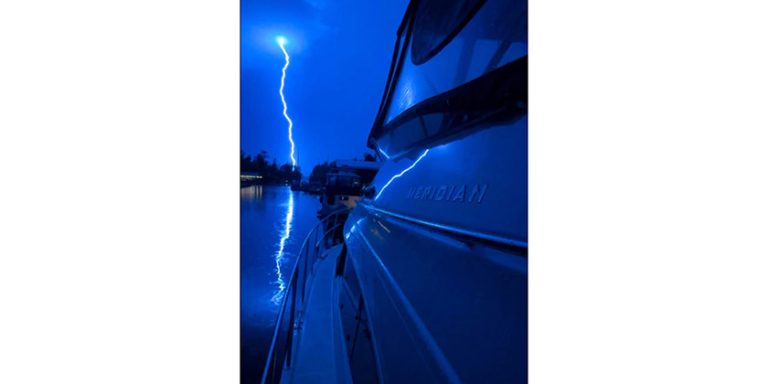
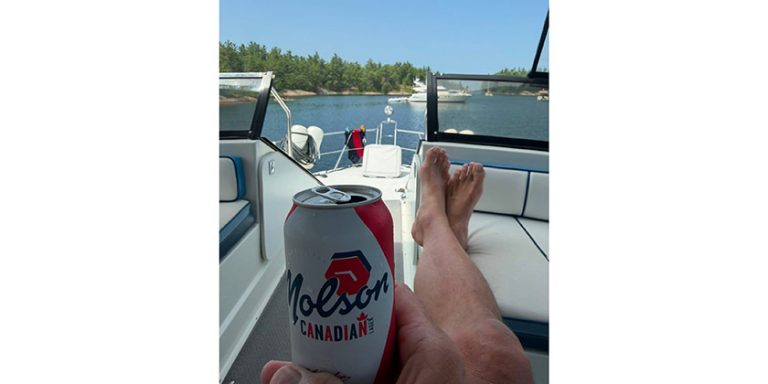
Videos appear to be taking over POTW but we still want your photos from the season past. Send them along to onboard@opmediagroup.ca and please note Photo of the Week in the subject line!