

Speed & Smarts: Review & Test – Sailing Smart Part 2: The Longer Tack

Jan 3, 2024
It’s still the winter; unless you are heading south, racing isn’t real for another few months. Studying continues. Last issue we looked at the starting line – now we will look more closely at the racecourse with questions 6 through 10.
The SMARTS section of the test is critical – if you go fast in the wrong direction, or if you let other boats control where you go, you will find yourself near the middle or back of the fleet. That’s why this test is all about how to sail smarter.
There are a total of 62 questions and answers about all aspects of strategy and tactics. Give yourself plenty of time to think about each question and answer, and don’t rush! Note that multiple choice questions may have more than one answer.
Questions: The longer tack
6. On beats and runs, it usually pays to sail the longer tack or jibe first.
T / F
7. The wind direction is 240° and from where you are the windward mark bears 230°. Which is the longer tack to that mark?
A) Starboard tack is longer
B) Port tack is longer
C) Both tacks are even
8. On a run you are sailing a heading of 065° on starboard jibe. Your heading on port jibe
was 025°. You take a bearing on the leeward mark and find that it bears 040°. Which jibe is longer? Both A) Both jibes are even
B) Starboard jibe is longer
C) Port jibe is longer
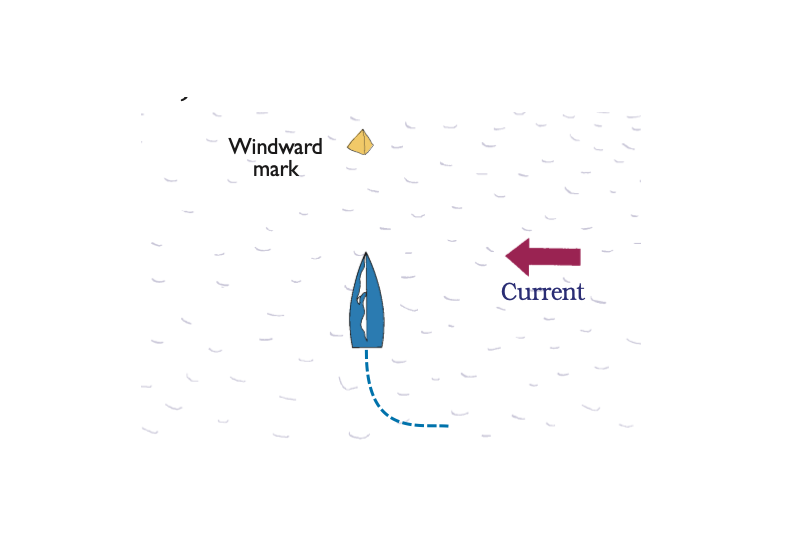
9. When you ‘shoot’ the wind before the start, your bow is pointing at the windward mark. There is current running from right to left as you look upwind. Which tack is longer on the first beat?
A) Starboard tack
B) Port tack
C) Both tacks will be even
10. Which of the following is not a good reason for sailing the shorter tack first?
A) There’s a persistent windshift
B) Current is better on one side
C) You’re not sure about the wind
D) You’re covering boats behind
Answers: The longer tack
6. True. By sailing the longer tack or jibe first, you keep more options. The shorter tack takes you toward the closer layline – the closer you get to the layline, the weaker your strategic and tactical position, both upwind and downwind.
7. A) Starboard tack is longer. If the wind direction (240°) is to the right of the bearing to the windward mark (230°), it means your bow will point closer to the mark on starboard tack and you’ll have to sail longer on that tack to get there.
8. C) Port jibe is longer. If you sail 065° on starboard tack and 025° on port, then dead downwind is right in between these, or 045°. If the bearing to the mark is 045°, you’ll spend equal time on each tack. But when the mark bears 040°, you’ll have to spend more time on port tack.
* Another way to think of this: If the leeward mark bears 040°, that is 25° off your heading on starboard jibe, but it’s only 15° off your heading on port, so port jibe is longer.
9. B) Port tack. The sailing wind makes both tacks even, but the current changes your course over the bottom. Since it is moving from right to left, it pushes you to the port lay- line sooner. So you will spend less time on starboard tack and more on port which takes you up-current.
10. C) You’re not sure what the wind will do next. It is usually wise to sail the longer tack first. It might pay to sail the shorter tack if that’s the best way to get a persistent windshift, find better current or cover boats behind. But if you’re not sure about the wind, that’s exactly when you should sail the longer tack first.
Next time – The questions continue – When boats converge
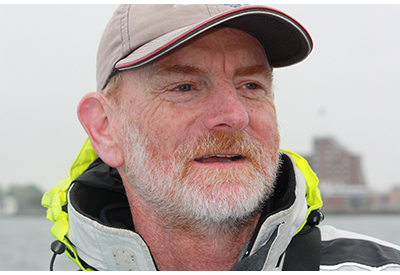
Dave Dellenbaugh is the publisher, editor and author of Speed & Smarts, the racing newsletter. He was the tactician and starting helmsman on America3 during her successful defense of the America’s Cup in 1992 and sailed in three other America’s Cup campaigns from 1986 to 2007. David is also two-time winner of the Canada’s Cup, a Lightning world champion, two-time Congressional Cup winner, seven-time Thistle national champion, three-time Prince of Wales U.S. match racing champion and past winner of the U.S. Team Racing Championship for the Hinman Trophy. He is currently a member of the US Sailing Racing Rules Committee (and was its chairman from 2005-2008).
You can subscribe to the Speed & Smarts newsletter HERE.