

Speed & Smarts: Part 2 – Factors That Influence Layline Position
April 19, 2023
Read Part 1 HERE.
A layline is the path you would sail, when steering your optimal upwind or downwind course, to get around the next mark on one tack. We all know that laylines are invisible, of course, but many sailors don’t realize how much (and how often) laylines move around.
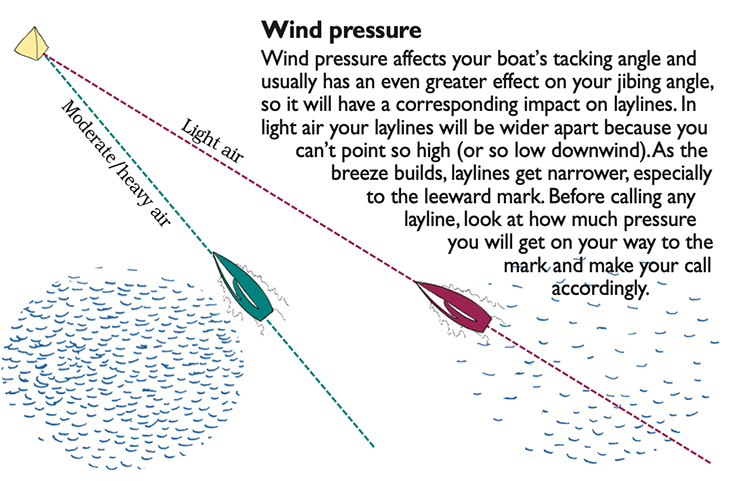
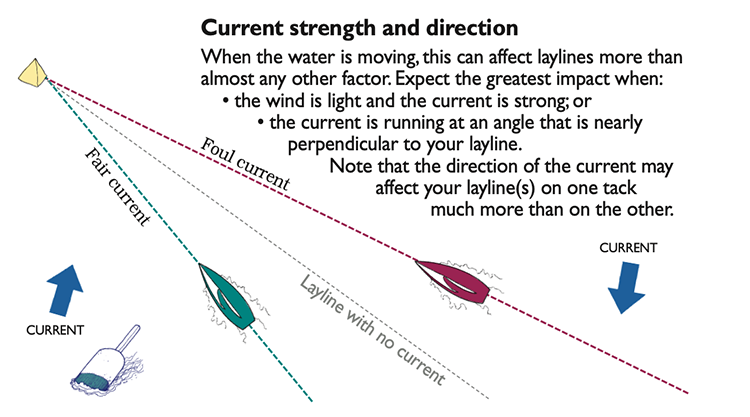
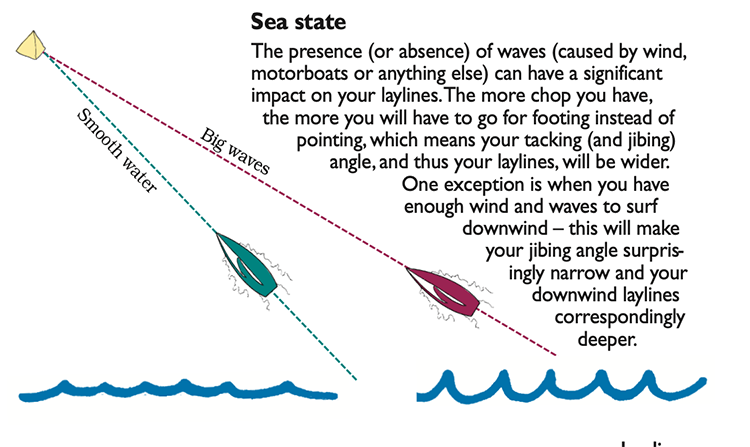
Laylines are a function of many variables such as wind direction, wind speed, sea state and current strength. Therefore, whenever there is a change in any one of these things (and they do change every moment), your layline will move. In order to make good layline choices, it’s important to keep your head out of the boat and to understand how all these variables may influence your layline calls.
Boat type – Laylines are, first and foremost, a function of your boat’s tacking and jibing angles. When you are sailing a narrow-winded Etchells, for example, you will obviously get to the layline sooner than you will in an Optimist, which tacks through about 90°.
If you haven’t done so, make up a chart for your boat that lists wind velocity and your corresponding upwind and downwind angles. Combine this with tacking lines to help make layline calls in any wind condition.
Wind direction – The wind direction is almost always changing, at least a little, and this has a direct impact on the location of all your laylines. For example, if the wind direction shifts 5° to the right, then the laylines will also move by 5°.
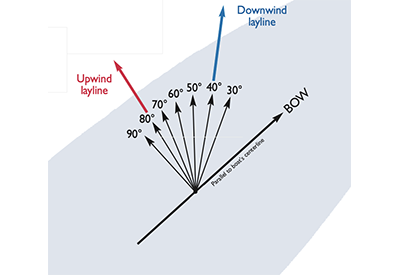
See above diagram on Tacking Angle
My favorite technique on boats that are big enough to fit tacking lines on their deck. To make tacking lines work, you need to know your boat’s tacking angle in the existing wind and sea conditions. You can determine this by recording your headings on each tack and finding their difference. Then sight along your tacking lines on the windward side to identify when you’re on the layline.
For example, if you tack through 80°, your heading on the opposite tack will be 80° from your current course. When the 80° tacking line is pointing at the mark, you are on the layline to the windward mark.
Tacking lines also work for downwind laylines. If your jibing angle is 40° use that line on your leeward side to sight the leeward mark.
On a shifty day, you must be tuned in to the windshift pattern in order to make good layline calls.
Leeway – One small influence on laylines is leeway (i.e. the angle between the course you’re steering and your course made good through the water). Every boat makes at least a little leeway because of the sideways push by wind and waves. This will be greatest (maybe 3° or 4°) in strong wind and big waves.
Next time: Should you ever reach the layline far from the mark?
 Dave Dellenbaugh is the publisher, editor and author of Speed & Smarts, the racing newsletter. He was the tactician and starting helmsman on America3 during her successful defense of the America’s Cup in 1992 and sailed in three other America’s Cup campaigns from 1986 to 2007. David is also two-time winner of the Canada’s Cup, a Lightning world champion, two-time Congressional Cup winner, seven-time Thistle national champion, three-time Prince of Wales U.S. match racing champion and past winner of the U.S. Team Racing Championship for the Hinman Trophy. He is currently a member of the US Sailing Racing Rules Committee (and was its chairman from 2005-2008).
You can subscribe to the Speed & Smarts newsletter HERE.