


Underwater Drone Follows and Films Scuba Divers
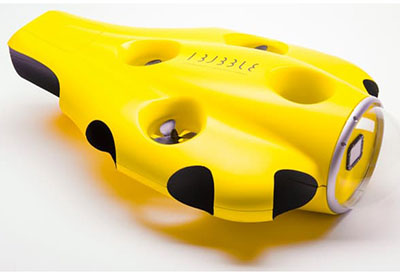
Many aerial drones now feature a Follow Me mode – that’s where they can be instructed to autonomously fly along above you and shoot video as you ski, cycle, run or otherwise move about. However, what happens if you’re a scuba diver? Well, in the near future, you might buy an iBubble. It’s a submersible drone that tracks its user as they swim underwater, using a proprietary technique that combines echolocation and object recognition.
The iBubble drone features eight motors to hold its own against moderate underwater currents (Credit: iBubble).
{videobox}v8hBZQ68ccE{/videobox}
Currently still in prototype form, the finished version of the iBubble will incorporate a distortion-free optical dome in which the user’s GoPro Hero 3 or 4 will be mounted. The camera will be supported by an image stabilization system, along with two 1,000-lumen lights providing illumination.
As with aerial drones, users will be able to instruct it to simply move along with them. Using a wrist-mounted remote, however, they can also get it to move around them in a horizontal or vertical loop (continuously facing in and shooting video of them as it does so). It has a maximum range of 25 m (80 ft) from the remote, and can descend to down to 60 m (197 ft).
A sonar-based obstacle-avoidance system will keep it from running into things like coral heads while it’s on the move. Using its object recognition system, it’s also possible to get it to visually “lock onto” a moving target such as a fish or sea turtle, then follow it while keeping it centered in the frame.
In cases where users want to get a close-up of something, they can use the remote to summon the iBubble over to them. It’s then simply a matter of grabbing onto it, switching it to manual mode, physically pointing it at the subject, and snapping a still or some video. Once it’s switched back out of manual, it will automatically resume following.
One charge of its lithium-polymer battery pack should be good for about an hour of use. When that battery gets low, the iBubble will automatically move over to its user. Should something go wrong, such as the battery dying completely, it will surface on its own.
The iBubble can also be used as a remote-operated vehicle (ROV), in cases where topside users want to check out what’s under the surface. In that situation, it’s hooked up to an optional 100-meter (380-ft) cable, and controlled from the surface using joysticks. A live view of its camera can be viewed on an attached screen. Similar functionality is offered by the Trident ROV, which is also currently in development.
Read the full story at GizMag.com