


All Boaters – Need Your Support to Continue the Safety Education and Distress Flare Disposal Program
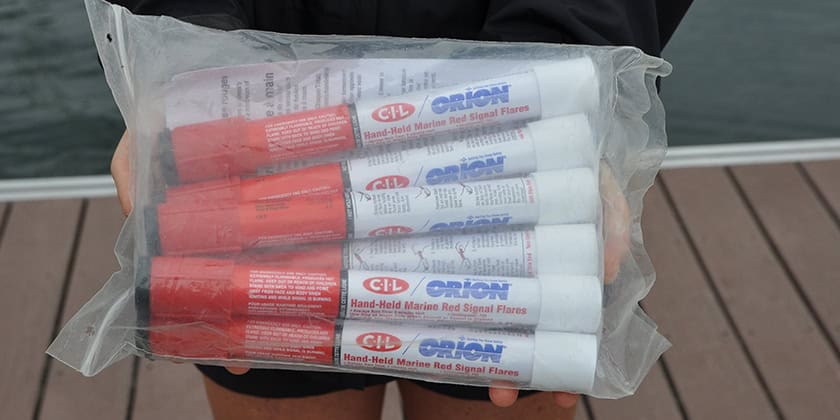
A typical safety kit plastic bag with distress flares.
September 11, 2025
Regular readers of OnBoard know that we are concerned about the loss of options for boaters to dispose of their expired Distress Flares.
Regulations in Canada require owners of larger boats to carry distress flares. Across Canada there are some marine chandleries and other retail outlets who may accept expired flares for disposal, but only when customers are purchasing fresh flares from the same manufacturer. Distress flares have expiry dates marked on them and beyond those dates flares may start to “weep” dangerous chemicals. The older the flare, the more unstable it could become.
Unfortunately, many boat owners still have expired flares on their boats, stored in garages and even in their homes. It’s impossible to estimate how many expired flares are out there across Canada, but it’s a big number.
In recognition of this and because these distress flares require proper safe disposal, Transport Canada previously had provided funding for a Safety Education and Distress Flare Disposal program. The program was delivered nation-wide through the Canadian Power and Sail Squadrons, now called CanBoat. This volunteer organization has trained many of their members in how to safely handle and transport expired distress flares. CanBoat has held many flares disposal days in locations all across Canada, and in both official languages.
Recently, the CanBoat Distress Flare collection days have gathered in an estimated 300,000 expired flares. There will be far more than that still out there on boats and in homes.
This past summer, CanBoat received no funding from Transport Canada. That grant money was provided to other programs and so, on a one-time only basis, the CPS Foundation funded the 2025 Distress Flare collection program with continued financial support from CIL Explosives.
CanBoat is applying for Transport Canada funding through their Boating Safety Contribution Program, to again hold the nation-wide Safety Education and Distress Flare collection days but we need your support to emphasize to Transport Canada that this program deserves funding.
We have drafted a form letter that you can download and send to Minister Chrystia Freeland and Transport Canada requesting that the funding be reinstated for the coming year.
Please take a few minutes to do this now. The grant application is going in soon and there will be other requests for Transport Canada support. Big numbers speak loudly. Every letter and email counts.
Here is the letter . Please send this today. Thank you!