


Amos Stevens
Mar 7, 2017
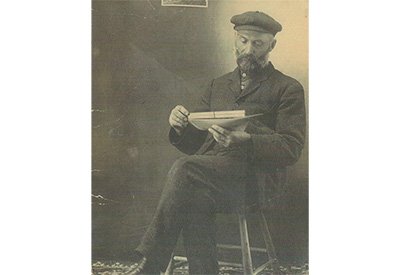
The Steven’s of Mahone Bay have deep boatbuilding and sail making roots. Sailmaker, Michele Stevens provided us with this interesting story of the man who began the family tradition.
It all started with Amos H. Stevens, born in 1850 on Tancook Island. He began his working life on the Schooner Bella Young but would return to his home island to begin, what was to become, an illustrious career in boat building.
It is true that Amos Stevens was not the first builder of boats on the island, however, he is credited with being the most innovative and prolific builder of what is known as the Tancook Whaler. The original whalers were clinker or lap planked, a method of construction which limited their overall length. He is also credited with building the first carvel or seam planked whaler. This method allowed the builder to butt join the planks and thereby increase the length of the boat. It is believed some whalers exceeded 50 feet in length. Until that time the length of the boats was restricted to the lengths of planks they could cut from a log.
These whalers served the fisherman and coastal traders of the era. Used for fishing during the spring and summer and later in the transport of the Island’s produce, cabbages, sauerkraut and fish to Halifax and other ports. Pictures taken at the turn of the century show whalers among the schooners and sloops racing out of Chester.
After the whalers served that generation, Amos went on to design and build the Tancook Schooner. These schooners were widely known along the Atlantic Coast of Canada and the United States. Unlike other schooners of that era, they have fine lines and are sleek and fast.
 Randolph told the story of how he and his brothers, Ernest and Ervine, were fishing for herring off Port Medway in a schooner named the Togo, built by their father Amos. They received word that the Halifax Herald had put up a trophy to be raced for by schooners from all the province. They pulled their nets and set sail for Tancook, arriving home late at night. They unloaded their catch and nets, washed down the boat and set sail at midnight, arriving in Halifax in time to enter the race. They beat all competition and won the trophy, which is currently on loan to the Chester Yacht Club, where Randolph sailed out of for 50 years.
During a period of some 16 years, Amos built 44 schooners ranging in length from 32 to 56 ft. After losing a foot in a mowing machine accident, Amos moved to mainland with his son Randolph where he enjoyed being with family until his death in 1935. His memory was honored in Lunenburg in 2005 as the Fisheries Museum of the Atlantic built and launched a Tancook Whaler bearing his name.
Good reads
The history of the Tancook Whalers and Tancook schooners is well documented in two books:
“The Tancook Whalers, Origins, Rediscovery and Revival” by Robert C. Post(Halifax Public Library has a copy)recounts the story of the whalers and the building of a thirty-four-foot replica, Vernon Langille at the Maine Maritime Museum’s Apprenticeshop in1978-79.
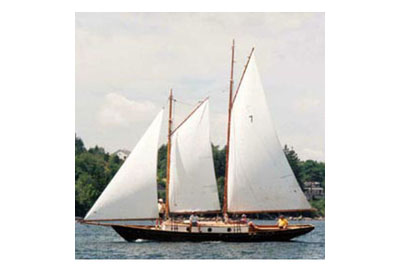 “The Tancook Schooners” by Wayne M. O’Leary (available from the McGill University Press) is an excellent description of life on Tancook Island and the development of what became known as the Tancook Schooner. These boats attracted the attention of several famous yacht designers and were well know in the US in the years before the Second World War.
Both books are well researched and worth searching out for anyone who wants to the know the history of two world famous small vessel types developed in Mahone Bay.