


Amendments to the Small Vessel Regulations
June 28, 2018
Effective May 16, 2018
1. Regarding Pleasure Craft Licenses:
• A Pleasure Craft License is valid for a period of ten (10) years beginning on the day on which it is issued, transferred or renewed.
2. Regarding Safety Equipment Carriage, Lifesaving Appliances:
• Paddleboats, Watercycles, Stand-Up Paddleboards and Sealed-Hull, Sit-On-Top Kayaks. If every person on board a paddleboat, a watercycle, a stand-up paddle board or a sealed-hull, sit-on-top kayak is wearing a personal flotation device(PFD) or lifejacket of an appropriate size, the paddleboat, watercycle, stand-up paddleboard or sealed-hull, sit-on-top kayak is required to carry on board only the following safety equipment:
a) a sound signalling device: and
b) a watertight flashlight, if the paddleboat, watercycle, stand-up paddleboard or sealed-hull, sit-on-top kayak is operated after sunset or before sunrise or in periods of restricted visibility.
• If the human powered pleasure craft is more than six (6) meters in length, a watertight flashlight and six(6) pyrotechnic distress signals, not more than two (2) of which are smoke signals are required.
3. Visual Signals:
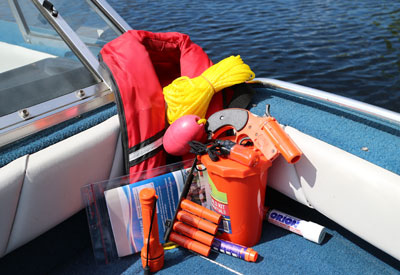
• For Sail and Power boats up to six (6) meters in length, if the boat is equipped with a motor: a watertight flashlight OR three (3) pyrotechnic distress signals, not more than one (1) of which is a smoke signal.
• For a pleasure craft more than six (6) meters in length and up to twelve (12) meters in length, the number of pyrotechnic distress signals referred to below may be reduced up to a maximum of 50%, provided the number of smoke signals does not exceed 50% of the permitted number of smoke signals, if the pleasure craft is equipped with:
a) A means of two way radio communication which can include a cell phone. If a VHF marine band radio then the operator requires a Restricted Operator Certificate (Maritime) (ROC(M); OR
b) A 406 MHz personal locator beacon, that is the subject to the technical acceptance certificate, worn by the pleasure craft operator; OR
c) A 406 MHz emergency position-indicating beacon.
• For Sail and Power boats over six (6) meters in length and up to nine (9) in length: three (3) pyrotechnic distress signals, not more than one (1) of which is a smoke signal.
• For Sail and Power boats over nine (9) meters in length and up to twelve (12) meters in length: six (6) pyrotechnic distress signals not more than two (2) of which are smoke signals.
By John Gullick
Manager of Government and Special Programs
Canadian Power and Sail Squadrons