


Plugboats: Sunreef Uses AI for Solar Panel Hull
May 8, 2025
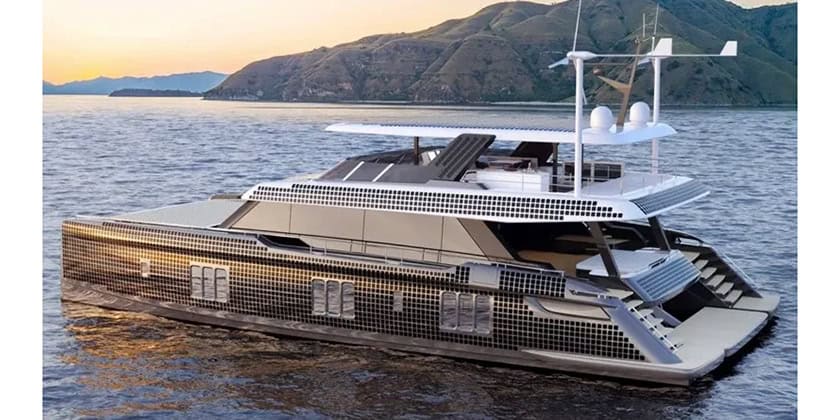
Sunreef Yachts, which developed the Solar Skin solar panel hull material introduced in 2022 and improved in 2024, has again boosted efficiency and performance with the launch of Solar Skin 3.0.
Solar Skin 1.0 was completely revolutionary, bringing to life the concept of embedding photovoltaic cells right into the composite used to build a boat’s hull, essentially making the entire boat an electricity generating solar panel.
Solar Skin 2.0 took things to the next level, with a 24.8% efficiency rating in turning light energy into electrical energy. That’s equal to the efficiency of the highest rated panels home panels. It also had excellent thermal stability and overall durability.
Solar panel hull efficient, durable
The 2.0 version operates at temperatures above the boiling point of water – 100º C/ 212 º F –and is highly resistant to microcracking, successfully withstanding over 20,000 mechanical load cycle tests that simulate different physical forces and weather conditions.
Not only that, but each individual ‘panel’ was equipped with an RFID chip, making diagnostics and maintenance easier throughout the yacht’s lifespan.
One of the issues with solar panels on a boat is that the light conditions are always changing, unlike a house where the amount of shade and shading areas are constant and easily analyzed.
Each panel functions as a smart unit
Sunreef Yachts’ CTO Nicolas Lapp explains how Sunreef approached the challenge: “Using AI, machine learning algorithms and real-time data from Sunreef catamarans operating in the Mediterranean, Caribbean, and Dubai, we have developed a system where we are able to continuously refine panel placement and optimize energy yield.
Each panel functions as a smart unit, dynamically adjusting its electrical output to mitigate shading effects from sails and superstructure, significantly boosting system efficiency, even during winter months.”
In the bimini areas, which are in shade most of the time, the new catamarans are now equipped with next-generation photovoltaic cells specifically optimized for shaded environments. All of this further enhances energy generation even under less-than-ideal lighting conditions.
The Sunreef Eco yacht line was first revealed in 2019, with the launch of the Sunreef 60 Eco during the 2019 Cannes Yachting Festival. It went on to win the Sailboats category of the Gustave Trouvé Electric Boat Awards in 2021 and the company repeated with a win in 2022 for the Sunreef 80 Eco.
In February the company announced the unmoulding of the hull for their new 43 meter (140 ft) Sunreef 43 Eco. It will feature over 120 m² (≈1,300 sq ft) of integrated solar panels, contributing to a total of 250 m² (2,700 sq ft) across the breadth of the yacht.