


CANSailGP’s Tom Ramshaw Talks with SinC
May 31, 2023
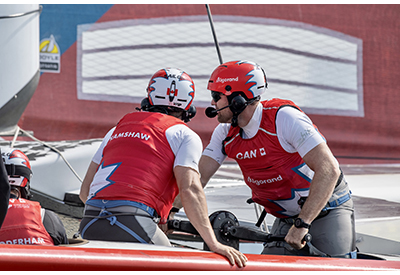
Facing forward, head up, Ramshaw has many tasks
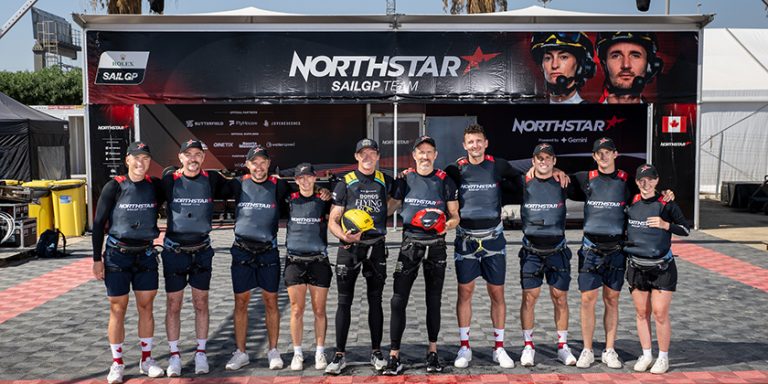
Right after CANSailGP wrapped up its surprisingly successful season, Sailing in Canada Editor, John Morris, caught up for a quick chat with Olympian, Sail Canada National Team member, and now CANSailGP grinder Tom Ramshaw, currently training in Puerto Vallarta.
Since he started sailing on Stony Lake at age 8, Tom Ramshaw has been a winner. His many faceted career has included Laser, the Olympic Finn as a National Team member and earned him Rolex Sailor of the Year in 2018 and 2022 Sail Canada Male Sailor of the Year. In 2021, Tom finished top ten for Canada in the Finn Class’s last Olympics before being dropped from the Olympic fleet list. He still had international wins in ILCA 7 but when the opportunity to join Canada’s Sail GP team in ’22 he leapt at the chance. Tom’s athleticism (he was also a strong hockey prospect) and sailing acumen come together nicely aboard the team’s F50.
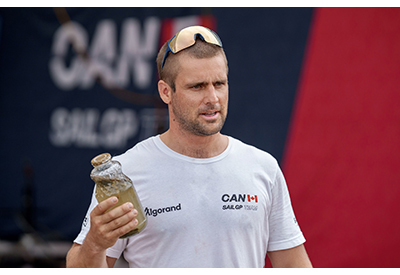 Tom: Even though my dad was on the Ontario Sailing Team, as a kid I never would have seen an opportunity to be a full-time sailor. Later, even as I saw pro activity in Europe and the US, I had no idea the opportunity for a Canadian could exist.
SinC: Being a grinder implies muscle, but you need a lot more than that, I’m sure.
Tom: Finn is super physical, so I love the workout, but that’s just part of my role. There are several things that keep me hectic.
Along with the rear-facing grinder we work with the wing trimmer non-stop. I also trim the jib, also non-stop. I am also responsible for inverting the foils on every maneuver, although the power for that is hydraulic.
Then, as the forward-looking crew closest to the bow I spend the entire time looking ahead and sharing info. Shifts, the water texture, traffic – I relay anything critical to the driver and tactician, without jamming the headsets.
 SinC: That’s where a lot of your experience helming Finns and Lasers helps.
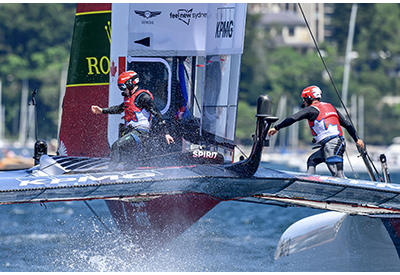
Tom: Yes, for sure, but in F50s it’s all happening at 60 mph. It’s mostly in the hands of the driver hand strategist, but I try to contribute as much as will be effective. Even when I am grinding, my head is up all the time. We had two and half weeks of intensive training and it certainly took some acclamation to get used to the speeds.
It’s the best. Foiling all the time. Imagine getting paid to sail – as I said, I never would have anticipated that! I am really looking forward to Season Two; as the saw in New Zealand, we will be a force to compete with.
I have been sailing solo boats non-stop, but this is a new and exciting experience; I love being part of a team.