


New Asian Carp Canada Website Makes a Splash
The Invasive Species Centre has partnered with Fisheries and Oceans Canada to launch a comprehensive Canadian website on Asian carps. Asian Carp Canada (www.asiancarp.ca) will provide information on all aspects of Asian carps, including the most recent prevention, warning, response and research efforts to address the overall ecological and socio-economic threats of Asian carps to the Great Lakes and beyond.
“Our Canadian oceans and watercourses are an important thread in the economic fabric of this country. They have supported commercial and recreational fishing and have been a way of life for generations of families. Since 2006, we have invested in science, prevention, early warning, rapid response and management and control. We are also proud to partner with groups such as the Invasive Species Centre to ensure that up-to-date information on Asian carps is available to all Canadians,” said the Honourable Gail Shea, Minister of Fisheries and Oceans.
The website will serve as a gateway to retrieve reports, fact sheets, webinars, maps and educational materials in a way that is easily accessible for a variety of audiences. Visitors to the website can explore information describing the four different species of Asian carps, their history in North America, and the ecological and socio-economic risks if they were to establish in Canadian waters. Visitors will also learn about the many efforts toward monitoring, prevention, and response in both Canada and the United States with an emphasis on Canadian actions, including work underway by Fisheries and Oceans Canada. The website also offers more technical and scientific information for those interested in exploring topics in greater detail.
Dilhari Fernando, Executive Director of the Invasive Species Centre said, “Asian carps are an issue that every Canadian needs to know more about. This website will offer a way to provide timely information and bring together stakeholders from across governments in Canada and the U.S., the private sector, educational institutions, recreational and conservation groups, and everyday Canadians. Increasing our collective knowledge and awareness about Asian carps will help to prevent their introduction into Canada.”
“If Asian Carps were to become established in the Great Lakes basin, they would pose a serious threat to the Great Lakes’ $5 billion fishery and have the potential to decimate native fish populations. The threat of Asian carps cannot be ignored and is something that the Ontario Federation of Anglers and Hunters does not take lightly,” said Angelo Lombardo, Executive Director, Ontario Federation of Anglers and Hunters.
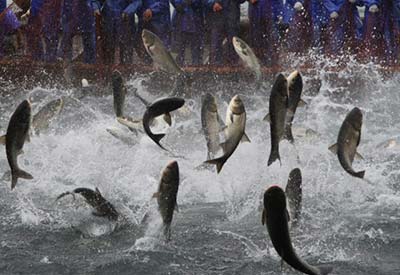
“Asian carps” refer to four species of carps (Bighead, Black, Grass, Silver) that are native to China and southern Russia. All four species have escaped into the wild in North America and three have established self-sustaining populations, particularly in the Mississippi waterway system in the United States. Beyond the tremendous socio-economic cost for the commercial and recreational fisheries, the establishment of Asian carps into Canadian waters poses a threat to native species and overall biodiversity because Asian carps are likely to alter fish habitat, compete with native fishes for food and space, and act as carriers for diseases or parasites.