


Candela’s electric C-pod combats heat with water
September 9, 2021
Swedish marine tech company Candela has unveiled the C-pod. It says the electric pod drive is four times more efficient than the best electric outboards, providing a silent boat ride and requiring no maintenance.
“The first obstacle towards a very small high-power motor is heat. You can take any motor and give it three times more electricity than it is rated for. It will work. But only for a few seconds. Then it melts. With Candela C-pod, we have almost unlimited cooling power – we just need to get heat from the coils to the surrounding water flow,” says Gustav Hasselskog, Candela’s founder and CEO.
By placing the motors under the water, he says his company has solved the heat problem. The pod drive is designed to be directly and efficiently cooled by the flow of seawater, thereby enabling higher operating temperatures and extracting more power from the motors.
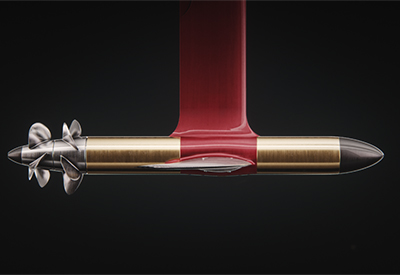
Hasselskog says that in traditional designs, a boat motor is typically situated in a box above the waterline, transferring thrust to the propeller through a complicated set of shafts, bearings and gears. The Candela C-pod gets rid of the gears, with two electric motors mounted under the water in a torpedo-like socket, directly driving the propellers. Each motor is coupled directly to a propeller, which reduces friction losses. Contra rotating propellers also provide high propeller efficiency, he says.
“The engineering challenge was to make the electric motors compact enough. Being submerged, they have to have a very small diameter in order to cause minimal drag,” says Hasselskog.
To accomplish this, Hasselskog says engineers worked to ensure the electric motor volume is not driven by power. Instead, it is largely proportional to torque. And power is torque times rpm. For the Candela C-pod motors, Candela opted to increase the rpm and lower the torque to boost the Candela C-pod’s power density.
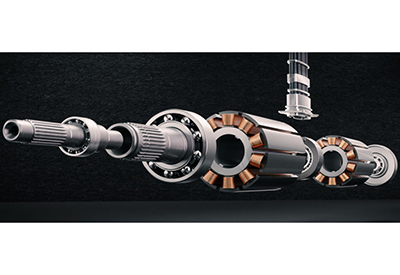 This was done by splitting the thrust needed on two propellers. The reason is that the maximum rpm is limited by the speed of the propeller tip moving through water. At around 45 m/s propeller speed, the pressure in the flow around the propeller reaches vacuum and starts to boil. That creates noise, damage and inefficiencies. The speed of the tip of the propeller is a product of rpm and propeller diameter. So splitting the load across two propellers allows for propellers with smaller diameter and thereby higher rpm – and in turn smaller motors.
Freed from gears and with very few moving parts, Candela who last month won an electric speedboat race, says its C-pod will last several thousand hours, without any maintenance whatsoever.
-Marine Industry News