


Ropes for Sailboats – Part 2
As Keven pointed out last issue “as the old saying goes, there are no ropes on a sailboat; only halyards, sheets, guys, vangs, cunninghams, barberhaulers, downhauls, furling lines, lifts, rodes and dock lines.”
May 24, 2023
As Keven pointed out last issue “as the old saying goes, there are no ropes on a sailboat; only halyards, sheets, guys, vangs, cunninghams, barberhaulers, downhauls, furling lines, lifts, rodes and dock lines.”
Spinnaker sheets
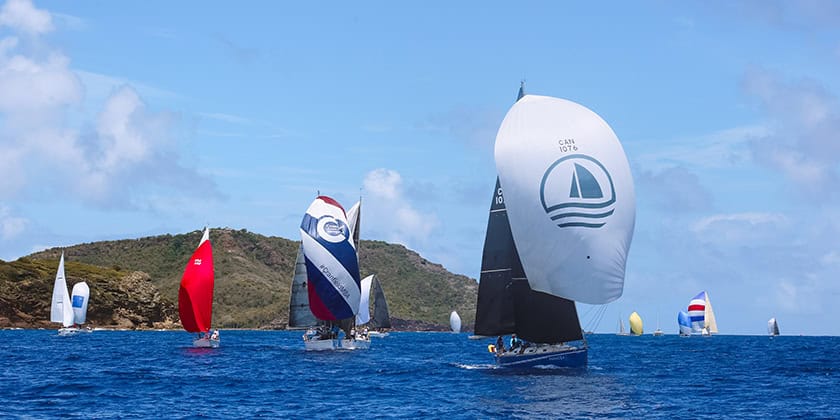
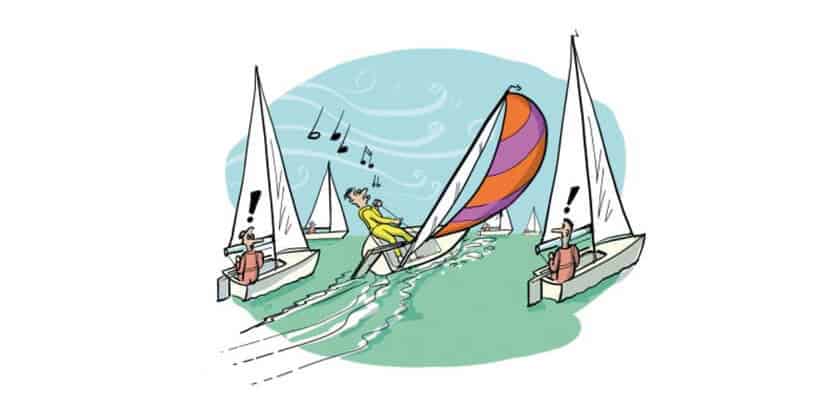
Spinnaker sheets on a conventional symmetrical spinnaker can make advantage from a low stretch performance rope. This is important especially when you are using a single set of sheets rather than double sheets and guys. The single sheets need to be light to help the spinnaker fly and when you reach, the loading on the guy end needs to give good control of the spinnaker pole to keep it off of the forestay. Due to the very long lengths, you can also consider tapering to save even more weight.
Spinnaker sheets on an asymmetric spinnaker are very long and are less loaded than symmetrical guys, so keeping them small diameter is helpful. The tack line however can have extremely high loading, so this is a good place to use a stout line and very low stretch if you are racing so that you can keep the tack down on the bowsprit.
Halyards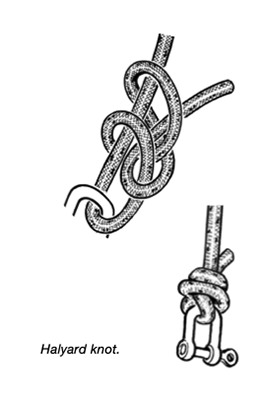 (Left) Tying a halyard knot
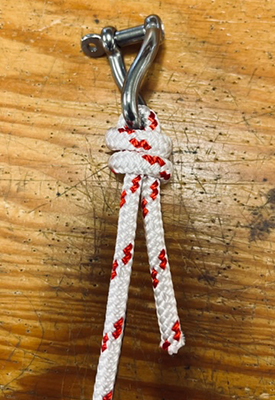 (Right) Halyard knot ready to go
Halyards are probably the simplest to choose. If you have a cruising boat, get the appropriately sized double braid polyester. This is a good place to spend more money on a premium heat-set double braid polyester like New England Sta Set, Samson XLS3, or Marlow Doublebraid. The tighter woven and heat set polyester ropes have very low stretch and stay very round to give good grip in rope clutches. You can also not bother with splicing these halyards and use a Selden Halyard Knot (See Fig 4 and Fig 5). This is a very secure knot that doesn’t use much rope to tie which allows you to end for end the halyard several times over its life to balance out wear and cut out worn ends over time. If you have carbon sails, consider some low stretch performance rope and even consider getting them tapered to save weight. Once again, no need to go super low stretch unless your sails are as well.
Control lines
Control lines are a great place to use single braid dyneema ropes as standing parts of cascaded purchases. Ideal use is boom vangs, outhauls, backstay tensioner cascades and other powerfully tensioned adjustments that have small ranges of adjustment. It is worth learning to splice 12-strand single braids for this purpose alone, and advanced splicing will allow you to make soft shackles and other handy pennants and such.
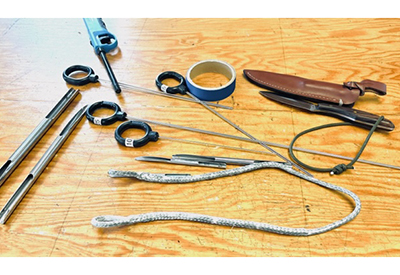 Splicing Kit
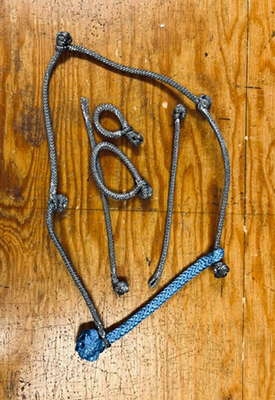
Soft Shackles in Dyneem
Keven Piper, two-time Shark 24 World Champion, founded Hamilton, ON-based Bay Sails in 1998. Email: baysails@gmail.com