


Sealing the boat’s prop shaft
June 11, 2026
In any boat with an inboard engine, the machinery that the drives the boat moves through the hull. An engine drives a propeller shaft, at the end of which is the propeller that moves the vessel through the water. This is as true of a bow-rider or a large sailboat, only the arrangement is different.
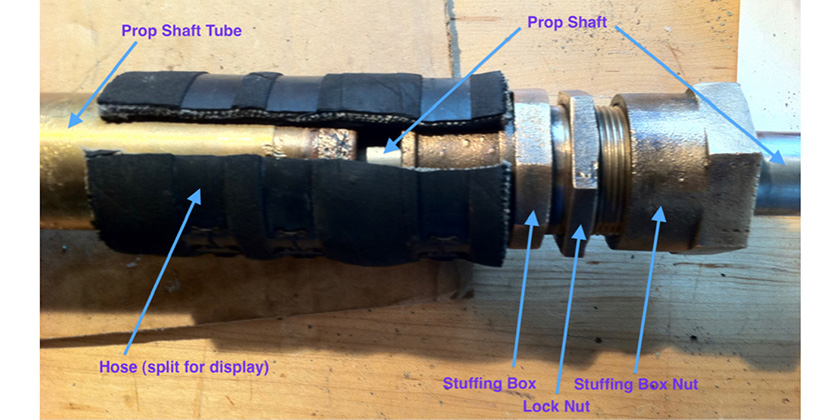
In a boat with a traditional prop and shaft arrangement, sail or power, the engine’s transmission turns a straight shaft, at the end of which is a propeller. The shaft passes from inside of the boat, where it is connected to the engine/transmission, through the boat’s hull to the open water around the boat. The shaft must be free to turn, but the hull also needs to be watertight. The way to meet both needs is to include a stuffing box at the point that the shaft moves through the hull.
The name is a bit deceiving – it is not box-like, and it isn’t filled with stuffing – rather, it is a tube that surrounds the shaft, with a tightening nut on one end. Behind and inside this nut, is a waxed rope that surround the shaft, but allows it to turn freely. The waxed rope (or ‘stuffing’) keeps water out, while allowing the shaft to spin. Over time, with seasonal storage and friction through use, the stuffing wears down and loosens. This allows water to enter the bilge more readily and is often the first sign that the stuffing box should be re-packed.
There are many types of stuffing boxes, with new ‘dripless’ technology readily available. In a more traditional stuffing box, dripping water (about one drip per minute) is the norm. The packing can be changed in or out of the water, with or without the prop-shaft installed – that said, it’s my experience that (due to the angles involved) it’s often much easier to do with the boat out of the water, with the prop and shaft removed first. However, in a pinch, and onboard, in water repair is often possible (and more cost effective).
Packing can be purchased at many marine chandleries in a variety of thicknesses (so it’s important to note what thickness is required for your set-up before you purchase). A pick (or specialty packing removal tool) will come in handy to remove old packing, as well as oversized adjustable wrenches to hold the stuffing box nut, and lock nut. Loosen the lock nut, remove the nut (or slide it back on the shaft), and inside the box itself will be the old stuffing. Pick or pry out the old packing material and cut the new packing to fit. To fit new packing, I wrap the cord around the shaft three and a half turns, and then make a cut using a sharp knife, along the shaft. This gives me three strands of packing that are exactly the circumference of the shaft. Pack each strand into the stuffing box, making sure that the seams oppose each other (don’t line up the seams on the same side or angle). Once re-packed, the nut and lock nut can be replaced. Tighten the nut to the point where the stuffing box drips once per minute, but not so tight that the shaft can’t turn freely.
Stern drives
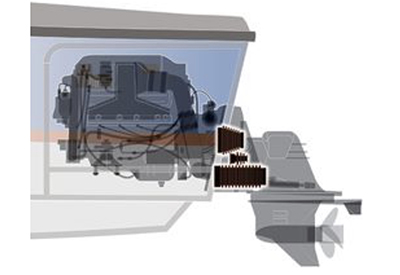
On boats with sterndrives, the machinery that runs through the hull are protected by ridged rubber boots or sleeves called bellows. Most sterndrives have three bellows: One for the shaft (connecting the engine inside the boat to the sterndrive outside of the transom) called the ‘U-Joint Bellows’, another for the cable that controls shifting (called the ‘shift cable bellows’), and a third for the exhaust. Because stern drives move side-to-side for turning, and up/down for trim, the bellows are continuously in motion, and are susceptible to ripping, tearing and wear. It’s common practice to need to replace bellows over time. A tear in the bellows can allow water to enter the boat quite quickly – so it’s an important maintenance item to check over regularly.
If you’re mechanically inclined, there’s money to be saved in a DIY bellows job, but there are a number of tools and tricks that make this an ambitious job for many boat owners. In either case – a stuffing box or bellows arrangement, water entering the boat at too fast a rate can (at worst case) cause damage or sinking – at best case it’s an annoyance! Make a review of these systems a regular item on your checklist and have them repaired as soon as you notice wear or damage.