


Cobourg Yacht Club
Katherine Stone
Like many other harbours on Lake Ontario, Cobourg has seen its fair share of changes. Screams used to be heard from kids piled into a toboggan on wheels that went hurtling down a wooden slide into the harbour. Above it all was the bustling din from the waterfront of ship’s whistles, train engines, foghorns and thundering coal cars. It is now a rather serene place for the locals and visitors to enjoy various watercraft. Fortunately, the beautiful beach that lines the waterfront is still a star attraction for the town.
Located 95 kilometres east of Toronto and 62 kilometres east of Oshawa on the north edge of Lake Ontario, United Empire Loyalists first starting arriving in the area as early as the 1780s. The first settlement in 1798 was called Buckville, later renamed Amherst, then called Hamilton (after the township) and also nicknamed Hardscrabble. It wasn’t until 1819 that they finally settled on the name of Cobourg, which was incorporated as a town in 1837. In the late 1820s large schooners with passengers and cargo had to anchor well off shore, as there was only a landing wharf. A group of Toronto businessmen formed the Cobourg Harbour Company which built the wooden Eastern Pier from tolls charged for the use of the harbour.
 By 1850 the town had taken control of the harbour, which could now accommodate some 100 steamships and schooners, making many improvements to the piers and enlarging the mouth. Many townspeople at that time felt that Cobourg would be the perfect capital for the newly united provinces. Alas it was never to be. But by the late 1800s it had become an American summer colony with many wealthy Americans building mammoth summer homes and grand hotels. By 1907, there was enough commuter traffic to support a major ferry service connecting Cobourg to Rochester, New York . Cobourg soon became known for its yachting regattas and was the third point in a race between Toronto, Rochester and Cobourg.
 Cancellation of the ferry service in the 1950s meant that the docks were vacant. A new rite of passage for local teenagers became diving off the 20 ft. dock and trying to swim from the centre pier to the west pier. Those piers were to shortly become the foundation of the Cobourg Yacht Club docks.
I was fortunate enough to encourage current Commodore, Rob MacLeod, to cajole several past commodores, Ralph Curtis, John Barton and Peter Sterling into telling their stories of the formation of the Cobourg Yacht Club this winter, when I entertained the idea of featuring CYC in Canadian Yachting. What follows is an interesting look over the past 50 years of how this club came to be.
In July 1964 the town approached some boaters and asked them to host visiting yachtsmen for the LYRA (Lake Yacht Racing Association) race, as the harbour was in great disarray with no proper facilities to launch, haul or dock boats. They formed the Great Pine Ridge Marine Association to host crews for the Freeman Cup (still run today as part of LYRA). Following the race, the town suggested that they start a yacht club. The Department of Fisheries and Oceans then ran the harbour and offered this association, now known as the Cobourg Yacht Club, a 99-year lease if they gave up the centre dock. Then the government would build docks on the east end of the harbour.  They also offered to let CYC run the marina, which the group wisely declined. CYC is now in the unique position of launching and hauling all boats in the harbour even though some are not club members’. The town runs the harbour and the marina and uses the dock rentals to fund the operation, which now boasts some 187 slips with 20 or 30- amp power.
They also offered to let CYC run the marina, which the group wisely declined. CYC is now in the unique position of launching and hauling all boats in the harbour even though some are not club members’. The town runs the harbour and the marina and uses the dock rentals to fund the operation, which now boasts some 187 slips with 20 or 30- amp power.The original clubhouse was erected in 1967 and with the purchase of the Red Barren (committee boat/ rescue boat), shortly thereafter they were able to provide a much needed rescue service, as there was no official coast guard nearby until the late 1970s. Ralph Curtis related that with help from the local Rotary and Lions clubs for rescue equipment and CFB Trenton’s donation of aluminum blankets, the boat was ready for service.
 John Barton recalled a funny story of a distress call from a sailboat that had run out of gas and couldn’t get into the harbour. Several club members piled into the Red Barren with some young sailing instructors to bring out a five gallon pail of gas to the unfortunate vessel. Upon arriving at the boat, they soon found out that the engine was a diesel! The Red Barren took all crew aboard to ferry them safely back to the harbour while the young sailing instructors hopped in the boat and skillfully sailed it back to the harbour. The young lads expertly docked the vessel to the cheers of many onlookers.
Back in the early days of the club, certified instructors were nowhere to be found. So members of the club who knew how to sail taught newbie members. The club first bought a set of blue jays which needed a lot of work and then eventually moved to albacores and CL16s. Peter Sterling recalls that a young couple were walking down the beach one day and the young lady inquired if they might rent a boat, as she was a certified sailing instructor. The yacht club’s reply was that if she was willing to teach first then she could use the dinghies…. That instructor was Diane Reid of One Girl’s Ocean Challenge and she became the first certified sailing instructor at Cobourg Yacht Club. Keeping their current fleet updated, the club took delivery of three new Topper Topaz boats last spring. The Topaz allows the jib to be removed for solo sailing practice.
 In the early days, the sailors owned and raced centreboards. Now, like almost every yacht club on the lake, more powerboats (the club now has eight trawlers), larger cruisers and keelboats are the norm. They have hosted many regattas including the Wayfarer North Americans in 2015, when they celebrated their 50th anniversary. There has always been a keen, but friendly rivalry with Port Hope Yacht Club. Racing for the Centennial Cup (an old brass cuspidor) was the perfect outlet with both clubs winning equally over the years. The CanAm series also ran for many years on Canada Day when visiting yachtsmen competed while their significant others combed the town for treasures in the shops. Wednesday night keelboat races have become a constant with three fleets, and often a fourth consisting of newer racers under white sail. Centreboards race on Thursday evenings.
 The cruisers keep busy with trips to Georgian Bay, Camelot and Endymion Islands in Gananoque and the annual Glen Island BBQ and cruise in the Bay of Quinte (hosted by the Rolph family), where members can either sail or drive to enjoy the festivities. The Power Squadron holds meetings and courses at Cobourg YC where many club members are also Power Squadron members. In the early years, the social scene was a big part of the yacht club during the summer, but closed shop at the end of the boating season. As land around the marina was developed in the 1980s and 1990s, more social and associate members started to join. Lead by Roger Cooper, pub nights were initiated as a low cost meal during the winter months. As one member outdid another and the dinners became more lavish, it all helped to promote the club and bring in more members year round.
As they have moved forward into their 51st year, many areas of the club have been spruced up in the 1985 clubhouse. (The original clubhouse has been repurposed as a sailing centre for centreboard boats and the sailing school.) This included maintenance and retention of club membership records, new deck and dining room furniture, and renovation of the downstairs service areas. With one of the finest vistas in town overlooking the harbour, they are a model for many other communities. Many things have changed in 50 years along with the membership  demographics. Large keelboats have replaced most of the dinghies, their membership now draws from Oshawa to Peterborough; new members have more expectations for services that didn’t exist 50 years ago, and over time, the totally self-help club has farmed out more specialized jobs. The past commodores all agreed that the only constant is change and to move forward they must continue on their path of change and rejuvenation to update shore facilities and expand slip availability in the marina.
demographics. Large keelboats have replaced most of the dinghies, their membership now draws from Oshawa to Peterborough; new members have more expectations for services that didn’t exist 50 years ago, and over time, the totally self-help club has farmed out more specialized jobs. The past commodores all agreed that the only constant is change and to move forward they must continue on their path of change and rejuvenation to update shore facilities and expand slip availability in the marina.Cobourg Yacht Club; P.O. Box 561; Cobourg, Ontario K9A 4L3; 100 Hibernia Street http://cobourgyachtclub.ca
 Photo Captions:
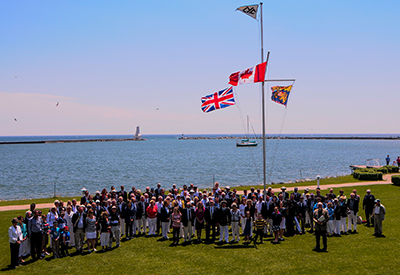
Photo 1 – The members gather on the lawn for Sailpast 2015.
Photo 2 – The Cobourg Yacht Club Clubhouse 2016.
Photo 3 – Junior sailors, meet your new 2015 instructors!
Photo 4 – The 1985 Clubhouse in 2015.
Photo 5 – The original clubhouse.
Photo 6 – Cobourg Yacht Club – celebrating 50 years in 2015.
Photo 7 – The original Red Barren.
Photo 8 – Performance sailing class.
Photo 9 – On the way to Thursday evening start.