

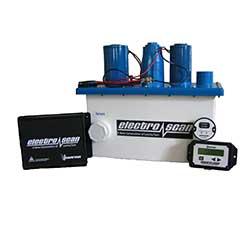
Electro-Scan Waste Treatment System
With increasingly stringent waste discharge legislation in both Canadian and US waters, boaters looking for waste removal solutions have at least a couple of options. Holding tanks are the obvious first-level fix but, of course, these need a pump-out station and there are not many of those on this coast.
Raritan has another option for vessels up to 65’ in length. The Electro-Scan system is a Type 1 marine sanitation device (MSD) that actually treats the waste water so it can be legally discharged back into the ocean. It cannot be used in absolute no-discharge areas such as Montague Harbour or Squirrel Cove, for example, but it can be used elsewhere to treat waste water so it can be safely and legally discharged.
The ElectroSan system provides a three-stage process, right at first flush. All waste is macerated into very small particles. Then it is treated by the installed electrodes that convert some of the included salt water into a bactericide and an oxidizing agent, both of which further treat the water. The next time the unit is flushed this waste water is sent to a mixing chamber and is again treated with the oxidizing agent which eliminates all odours. The third phase does a final treatment, which reduces the bacteria count below the legal limit so the fully-processed water can be returned to the ocean.
While the process sounds complicated, it is actually fully automatic so that boaters need not worry about operation, it works unseen and unheard, and it meets all appropriate US and Canadian regulations.
The ElectroSan system is available for 12, 24 or 32-volt marine systems. Retail prices start at about $1,600 plus local installation.
CORRECTION
We erred in our description of the Raritan Electro-Scan sewage treatment system. The manufacturer claimed, and we repeated, an incomplete statement that this system treated onboard sewage to a level safe enough to pump overboard with no further treatment. In fact, this is only true in some jurisdictions in the United States. It may be true in Washington State, for example, but it is not true in Canada.
In Canada now, no discharge at all is allowed within one mile of shore. And discharge is only allowed directly into the ocean at locations three clear miles from shore. Of course, there are exceptions allowed for maritime areas of inlets, bays and such where there never is a body of water three miles from shore.
In effect, while in Canadian waters a holding tank will almost always be needed, so the Raritan system doesn’t offer as much of an advantage. Watch for a complete review of the newly updated Canadian sewage regulations in a future issue of Canadian Yachting West.