


Buyer Aware: Taxes, Duty And Tariffs
December 4, 2025
By Colin Andrews
The latest news on the tax front is that the Liberal government’s budget, recently passed in Parliament, contains a provision to eliminate the Luxury Tax on boats and airplanes. For context, this saves over $25,000 on a boat worth $300,000 before 13% HST.
One of the more troublesome aspects of the Luxury Tax was that it applied, selectively, to boats built after 2018. The Luxury Tax was a financial failure, generating only about 25% of projected revenue. The more damaging failure is the loss of the HST on boat sales that were never made. The tax disrupted the new and used boat market to an almost fatal degree.
With interest rates down to manageable levels and the absence of the Luxury Tax it is reasonable to anticipate a gradual return to the boat market of new boat purchases bringing more used boats into resale market, with an increase in the supply of both new and used boats. During Covid and with the Luxury Tax, the supply of used boats was generally of older boats. Depending on the strength of uptake of both new and used boats it could be a few years before the used boat market regains a healthy balance of recent and older boats.
New Boats
If our free trade agreement with Mexico and the US remains in place, as it is now, sales of new US-built sailboats and powerboats will resume. These arrive in Canada duty-free and, for the time being, tariff-free. This applies to Mexican and US-built used boats as well. Imposition of a tariff and possibility of a Canadian retaliatory tariff would upset this market segment significantly, but that isn’t part of this scenario at this time.
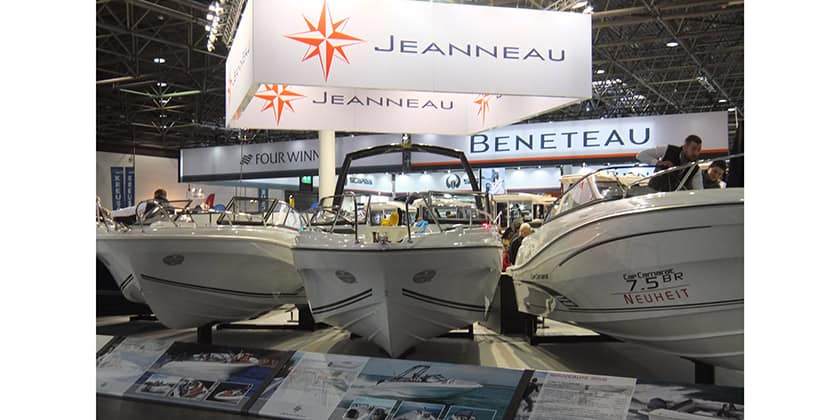
Canada’s CETA (Comprehensive Economic and Trade Agreement) free trade agreement with the European Union may see the biggest resurgence in new boat sales with the elimination of the Luxury Tax. New boats from the high volume builders, notably Beneteau, Jeanneau, Hanse, Bavaria, both power and sail, arriving directly in Canada are duty-free and are very competitively priced.
When a new boat is bought the selling dealer collects the HST at Closing and remits to CRA on the buyer’s behalf. When a used boat is bought from a dealer, typically when the boat has been taken into the dealer’s inventory as a trade-in, the dealer will collect the HST on Closing.
What about Used Boats?
The caveat is in the word ‘new’. CETA, for Canadian duty purpose, includes only those remaining in CETA jurisdictions prior to purchase and import into Canada. But importing used boats from Europe is a rarety; most people are accustomed to shopping in Canada or south of the border for their used boat, including some originally built in Europe.
Beneteau and Jeanneau were built in the USA for many years but Beneteau closed the South Carolina factory and all Beneteau and Jeanneau production went back to Europe. If you buy a used Beneteau or Jeanneau you need to know which country it was built in. If built in South Carolina, no problem, the North American free trade agreement applies. If it was built in Europe but lies in the US ,it is subject to Canada’s 9.5% duty on arrival here from the US. If you’re shopping for a J Boat, the same applies. J Boats build numerous models in both the US and Europe and you need to know in advance, the country of origin.
The easiest way to ascertain that status is the HIN, Hull Identification Number. If the HIN has a prefix such as FR, the boat was built in France. Brands such as Bavaria, Hanse, Moody, Dehler, Axopar, Excess, Lagoon, etc., were never built in North America, so their duty status is clear: don’t buy these for import into Canada from a non-CETA (ie US) jurisdiction if you don’t want to pay the 9.5% duty.
BEY78059H001 is the HIN of a 2001 Beneteau Oceanis 331 built in South Carolina. The absence of the prefix FR- is indicative of it being built in the US, not France. The last two numbers, 01, denote the model year, 2001. The boat may have been built in August 2000, for example, but under the protocol for build year and model year, similar to cars, it is a 2001 model. That is the year used for licencing, registering, insuring, buying and selling, etc.
Circling back to the beginning for more on taxes; when you buy a used boat privately or via a yacht broker, HST is may not or may not be collected at Closing depending on the dealer, province etc. When the buyer applies to transfer a boat licence or register the name, through Transport Canada, a notice is sent to CRA that a taxable transaction has occurred. It is then up to CRA to generate and send a bill to the new owner for payment of the sales tax, 13% HST in Ontario, somewhat different in BC and other provinces. It is absolutely not the responsibility of the buyer to approach CRA to pay the tax – you wait for the bill to arrive.
About the author
Colin Andrews is the senior broker at Port Whitby Marine Centre’s Swans yacht sales division. His involvement in the boating industry spans manufacturing, distribution and services sectors, dating from university onwards. He is an active member of Ashbridge’s Bay Yacht Club and happily sails, with his spouse, Barb, aboard their Beneteau 331. Sailing interests include racing, race committee, cruising on Lake Ontario and Caribbean charters.