


ENVGO NV1: Back to the Future
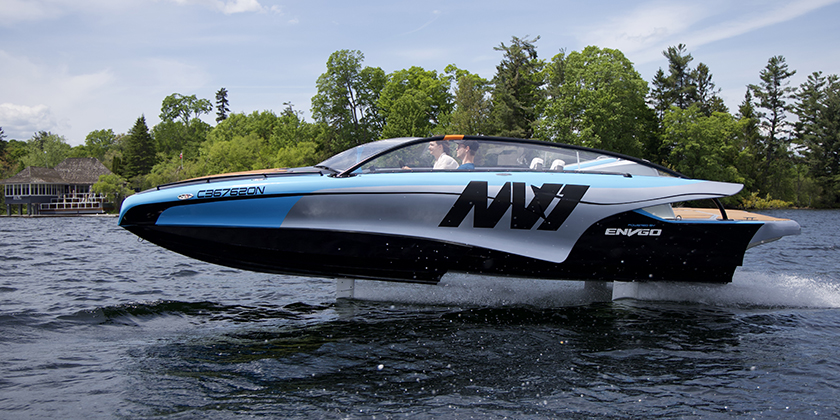
The ENVGO NV1 — a Canadian performance foiling electric boat.
Story and photos by Andy Adams
Up to this point, I feel that most electric boats have not been very exciting. The motors have been mainly small portable models for dinghies. There are some high-horsepower motors available, but they look like regular outboard motors to be used on conventional boats. Until now, there hasn’t been an electric boat that really makes a statement. Enter the ENVGO NV1.
With the recent rise of tensions between the United States and Canada, where US President Donald Trump has openly taunted us with becoming the 51st state, criticized Canada for not contributing 2% of our GDP to NATO, imposed significant tariffs on our steel and aluminum industries and pushed to relocate automobile manufacturing from Canada to the US, we need to get more independent. Part of that may be getting into the defence industry.
Today, Canadian Prime Minister Mark Carney is re-examining Canada’s earlier commitment to purchase F35 stealth fighter aircraft from the US. From Sweden comes an alternative supersonic (although non-stealth) fighter called the Gripen. This less expensive aircraft is already in use by NATO in countries around the world and is effectively sold out. This creates an opportunity where Gripen production could be started up in Canada. Our Bombardier aircraft manufacturing facilities are already building aircraft. Could this be the resurgence of Canadian defence industry manufacturing?
With that in mind, and with striking styling that conjures up images of fighter jets, we have the introduction of the ENVGO NV1, which will make its public debut at the 2026 Toronto International Boat Show, January 17 to 25, 2026.
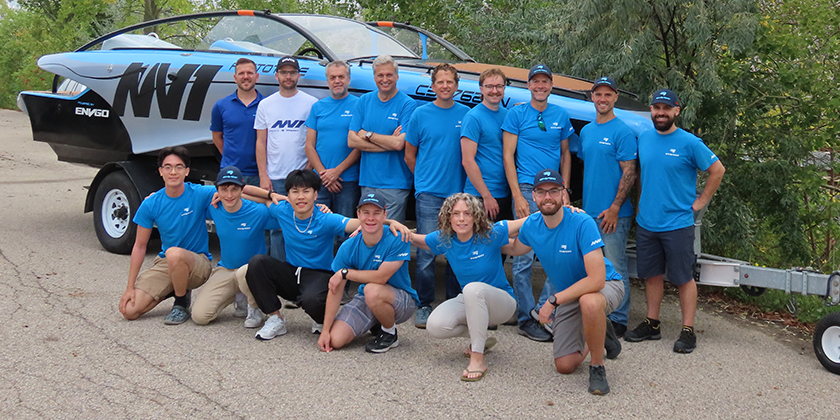
A team of talented Canadian tech developers who previously founded Canadian drone company Aeryon Labs, serving the public safety and defence markets, are behind the creation of the ENVGO NV1 performance foiling electric boat.
Canadian Boating has been following the ENVGO NV1 project for more than a year now, and we had our first opportunity to see the NV1 in person for a demonstration ride last September.
FIRST MEETING WITH THE NV1
We went out on the prototype for a couple of hours of fun on Lake Ontario. Mild weather and a light chop were delightful conditions.
There were few other people around so I wasn’t able to get any first impressions from onlookers, but it was easy to see that the NV1 was going quickly, flying above the waves like a “hover-boat”!
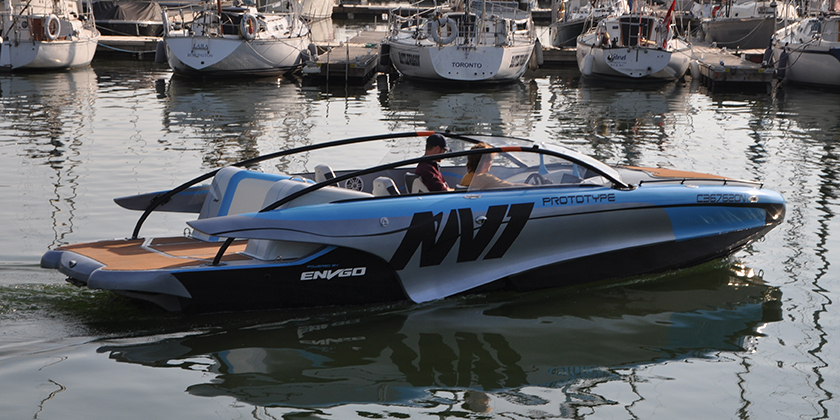
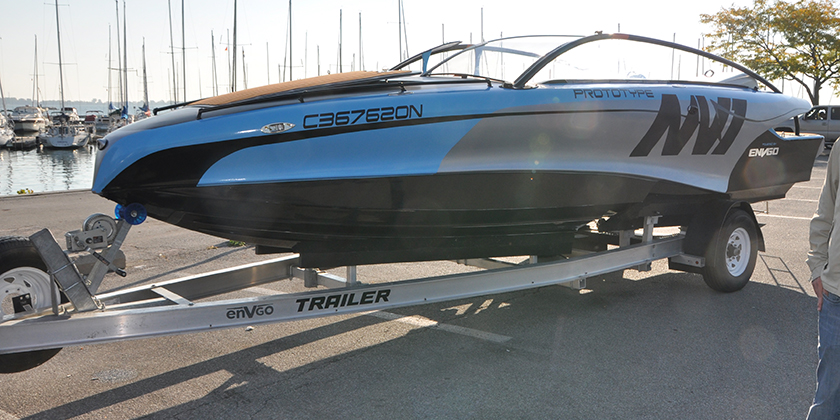
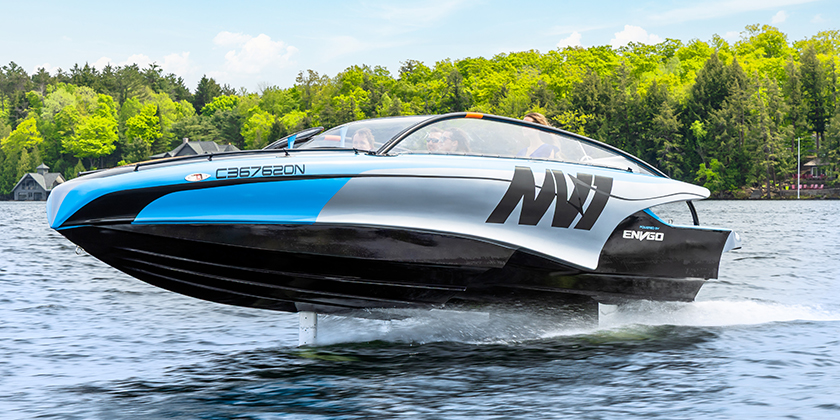
The boat’s styling is the “grabber”. Even on the trailer, the 25-foot NV1 is a head-turner. It doesn’t look like any other boat in recent memory, but it’s a great looking vessel, and the production model will seat six in comfort. The windshield reminds me of a jet fighter too.
ENVGO’s team, led by Mike Peasgood, came with him from Aeryon Labs, which was successfully acquired in 2019. The team brought their deep aerospace experience in flight control and autonomous systems into marine. To round out the expertise demonstrated in the NV1, they leveraged Designova, a well-recognized Super Yacht Designer, as well as noted Canadian Naval Architect Steve Killing, who holds deep roots in foiling with his America’s Cup credentials.
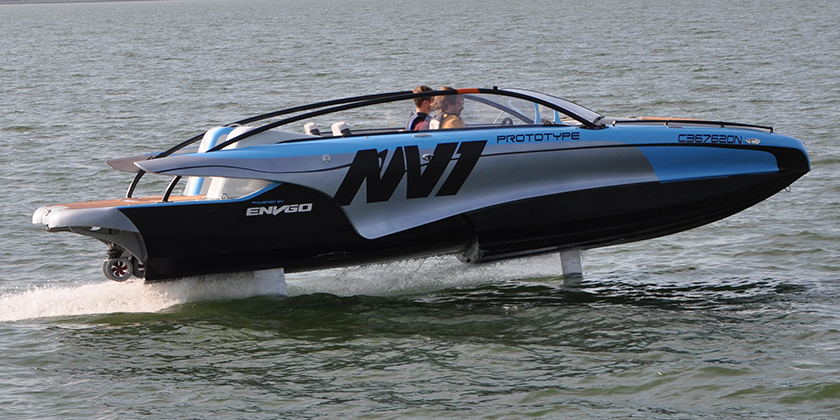
Their goal was to create an exciting and aspirational boat that delivers the experience of boating in the future. With twin battery-powered electric motors on the aft foil plus a bow foil, the boat starts off like a regular boat, but as speed rises, it lifts to start riding on the foils. The takeoff transition was very smooth!
LET’S GO FOR A RIDE!
The NV1 is a late-stage prototype, and ENVGO team member Sam Domaratski was at the helm for my ride. He eased the NV1 away from the dock, with the control system automatically driving the two props and stern thrusters. No sound or motion gave away what Sam was doing. We just glided out of the marina fairway and into Lake Ontario. When we reached sufficient depth, Sam deployed the foils, moved the throttles up, and the NV1 picked up speed and rose onto the foils. The sound of water on the hull was replaced by wind. I could not hear any engine sound or the water on the hull.
A ride in the NV1 is a unique experience. Not only does it leave very little wake or noise, the electric motors are fully submerged, powerful and create zero emissions. There was no abrupt crashing through waves, no noise, no disruption to others on the water or the shoreline—just pure flight.
Steering is accomplished by vectoring the twin motors. At present, the NV1 does not turn sharply, but the ride is serene and the NV1 is quite comfortable. The whole boat flies above the waves, which greatly minimizes the drag a normal hull would suffer. Plus, it all but eliminates any wave impact or discomfort.
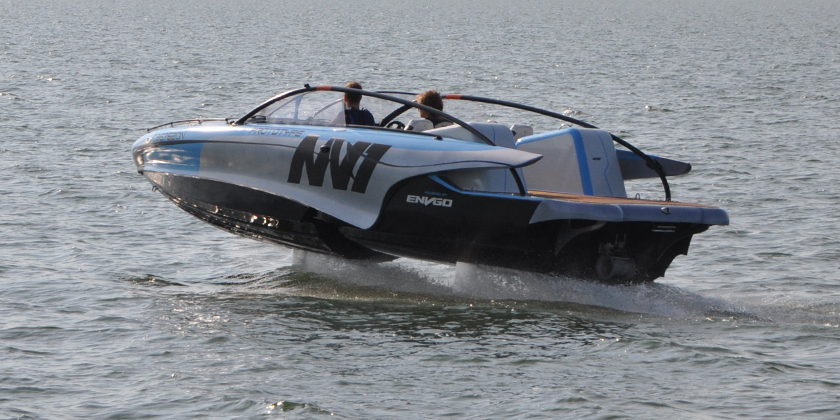
The biggest challenge with today’s electric boats is that an electric motor on the same hull as a conventional motor doesn’t get nearly the same range. With the foils, you get conventional boat speed and range on a single charge. The ENVGO team says that foiling lifts the hull, cutting drag from the water and increasing the range by a factor of up to 4x.
The NV1 is, of course, powered by batteries, and the battery banks are sourced from the electric vehicle industry for cost-efficiency and ease of use. Owners are likely to just install an EV charging system in their boathouse, as many people have done at their homes. Plug the NV1 in and walk away, and it will be ready to go again tomorrow, if not sooner. Marinas are increasingly likely to have charging available too. At present, the NV1 has an 80-kW hour lithium EV battery, designed with thermally-isolated NMC cells for safety and maximum performance.
UNDER THE HOOD
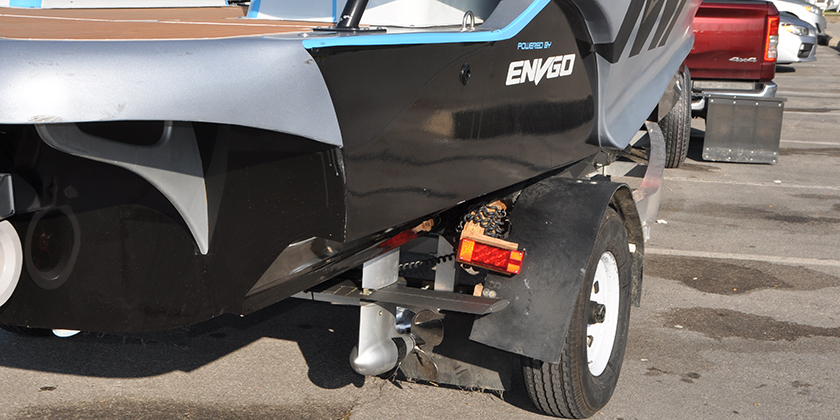
On the stern deck of the NV1 are boxes on the port and starboard sides (like small motor boxes in a conventional boat) and these are the housings and mechanism for deploying the foils. The bow foil mechanism is under the front deck. On the trailer or at low speeds, the foils retract, minimizing the water depth needed to dock or maneuver.
Like an airplane wing with flaps, the foils are adjustable, with ENVGO’s flight control software making split-second changes to maintain the boat’s ride attitude as it passes over waves, banks into turns or stays level through the chop.
HELM AND CONTROLS
A great feature planned for the NV1 will be a sensor system to detect underwater obstructions or even a person in the water. But the NV1 will have far greater capabilities than just that. Like driver’s assist on the latest luxury cars, the NV1 will have docking assist with a 360-degree birds-eye view displayed on the centre MFD.
NV1’s capabilities span across a broad segment of recreational boaters, from luxury cruising with friends right through to dropping your line in the water. In fact, the flat floor extends right to the back of the boat, perfect as a swim deck with an installed ladder or for working a fish.
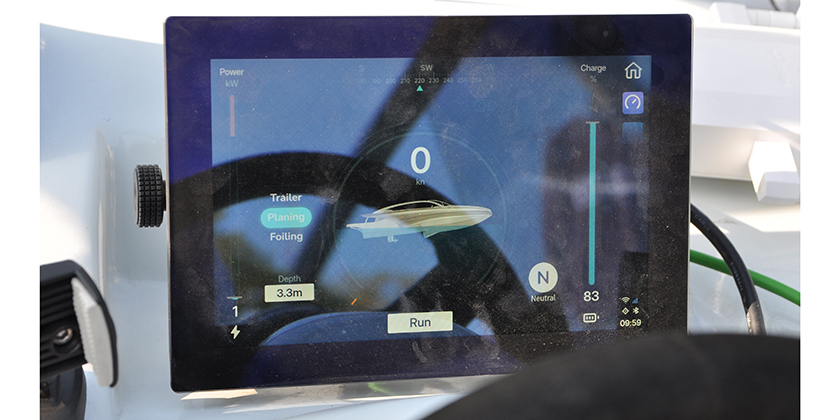
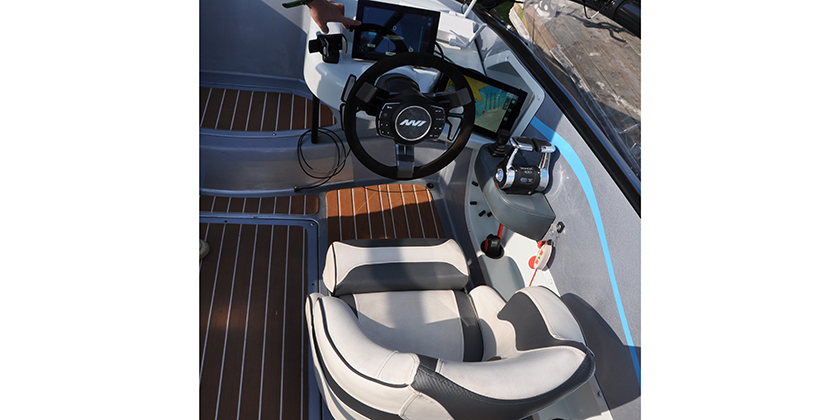
The helm is on starboard and was equipped with twin screens. The centre screen shows power levels, water depth, and settings for the foils with presets for being on the trailer, planning or foiling. The display shows compass heading, charging information, Wi-Fi strength, Bluetooth connectivity and more.
The second screen is normally for navigation with chart display and other information. Talking with the founders after our demonstration ride, they wanted to emphasize that they were focused on providing boaters the experience of flight, but not the difficult task of operation. This is where their comprehensive flight control systems come into play. NV1 is complex under the hood, but simple to use.
ENVGO’s NV1 will be going into production this spring. They are currently in the final process of refining NV1’s complex control systems to ensure simple and seamless operation for recreational boaters. The NV1 will be a floating super computer and the years of experience the team gained at Aeryon Labs will be put to new use. So, let’s get back to the future with the NV1!
SPECIFICATIONS
LENGTH: 25′ / 7.62m
BEAM: 8’ 5” / 2.4m
PASSENGER CAPACITY: 6 persons
WEIGHT: 3,750lbs / 1,700kg
PROPULSION MOTORS: Twin 120kW peak electric motors
BATTERY: 83KW/h
BATTERY SAFETY: Active cooling, BMS
NAVIGATION: Twin differential drive & Stern thruster
CRUISE SPEED: 40kph
TOP SPEED: 80kph
RANGE @ CRUISE SPEED: 100km
PRICE: Starting at $550,000 CAD
For the latest specs and updates, go to:www.envgo.com and @envgoboats on Instagram.
ENVGO’s representative, Pete Keller, can be reached at pkeller@envgo.com