



Reliance 12 Meter
Have you ever realized, while sipping drinks in the cockpit after a friendly Wednesday-night race, that the great expanse and expense of accommodation down below is never used? If you answered “yes,” you may be one of the many people to whom Reliance Sailcraft in Montreal has spoken.
Reliance produces a 44-foot cruising boat, whose buyers are diehard, honest to goodness pleasure sailors who generally live onboard. But the company has been hearing increasingly from those who really only want a big daysailer, something like an up-to-date 8 Meter, or a big Etchells-22, or a small 12 Meter everyone has their own way of describing the concept. Although having their cruiser and this new day racer come out of the same shop seems as contradictory as putting baggywrinkle on rod rigging, the logic is sound.
With such a clearly defined philosophy to work with, it was a pleasure to be selected as the designer for this new boat. “It must look fast and be fast,” I was told. “When the owner steps onboard he should be able to imagine that this is a real 12 Meter.” Exciting parameters for any designer.
The next sequence of decisions went something like this. To achieve the visual similarity to Meter boats, the beam had to be narrow. That meant either the sail area had to be minimized or the ballast increased for stability. The choice was now between a very light-displacement boat with a small sail area (ULDB) and a medium-displacement powerhouse. No question, said Reliance. The only choice is the heavier displacement configuration: it must have the feel of an old Meter boat.
A quick glance at the profile tells you that the Meter boat analogy stops with the keel. Unencumbered by the International Rule, ballast is placed in a high-aspect foil for efficient windward performance.
And how did we get standing headroom in all this? We didn’t. A simple yet functional interior features full sitting headroom; it is hoped that the crew will spend most of their time on deck, relaxing in the cockpit. A great deal of effort was put into pampering the helmsperson with a separate cockpit, a large-diameter wheel and instrumentation close at hand. Forward in the crew cockpit, the coamings are chamfered for comfortable seating whether heeled or at the dock.
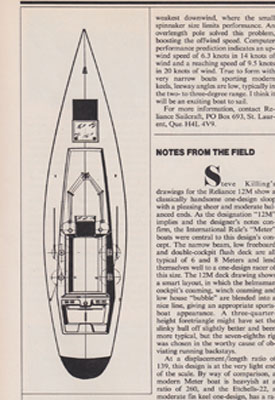
We had some fun with the sail plan. A fractional rig was selected to control headsail size (the design features an optional self-tacking blade jib), thereby putting much of the sail area into the easily controlled main. Not wanting the hassle of running backstays, the attachment point of the headstay was raised above the Meter class norm to reduce bend in the spar and increase headstay tension. A fractional rig is normally at its weakest downwind, where the small spinnaker size limits performance. An overlength pole solved this problem, boosting the offwind speed. Computer performance prediction indicates an upwind speed of 6.3 knots in 14 knots of wind and a reaching speed of 9.5 knots in 20 knots of wind. True to form with very narrow boats sporting modem keels, leeway angles are low, typically in the two- to three-degree range. I think it will be an exciting boat to sail.
For more information, contact Reliance Sailcraft, PO Box 693, St. Laurent, Que. H4L 4V9.
NOTES FROM THE FIELD
Steve Killing’s drawings for the Reliance 12M show a classically• handsome one-design sloop with a pleasing sheer and moderate balanced ends. As the designation “12M” implies and the designer’s notes confirm, the International Rule’s “Meter” boats were central to this design’s concept. The narrow beam, low freeboard and double