

Safe Anchoring Basics – Selecting your Anchor Size
Dec 5, 2019
Years ago anchor weight was the only criteria. In today’s world anchor design and construction metals is important and allow for lighter, stronger anchors with, in some cases, even greater key holding power, as found in US Navy testing.
These proven, in global testing, lighter anchors make it safer and easier for many in the crew to be able to heft and deploy the anchors.
Your Boat size, beam and windage, location, scope and bottom conditions are key factures in your anchor sizing. We’ll cover each of these in this article.
Anchor selection
Your “Lunch Hook” should be able to hold your boat in a 15 Knot breeze.
“Main Anchor” up to 30 Knots wind
“Storm Anchor” Up to 42 Knots wind
Example: A 30 ft boat with standard windage.
Wind speed Knots Holding Power Lbs High Beam/Windage
15 K 175 Lb 225 Lb
30 700 900
42 1400 1800
60 2800 3600
So remember this: As wind speeds double: holding power required quadruples!
Adequate Scope;
Normal anchoring, use at least 5:1 scope (length of anchor line relative to water depth under the hull.)
A 10:1 scope will up to double your holding power.
Anchor Setting
Deploy your anchor and back down VERY slowly to allow anchor to set. As the anchor begins to set VERY slowly increase the load with your engine to allow anchor to set . Always, in changing tide or winds; set two anchors off the bow in opposite directions
Anchor Retrieving
Position the boat as you retrieve the line slowly, over the anchor. Snub line on cleat and slowly back up to pull the anchor free.
Anchor Rode
You can use a short length of chain 6Ft and 3 strand nylon line to help reduce shock loads on the anchor. The chain protects the line from sea bottom chafe and helps in setting the anchor.
In 25 ft water or less use 6 Ft chain. Add 6ft for every 25 ft of depth thereafter i.e. 100 ft water depth needs 24ft of chain.
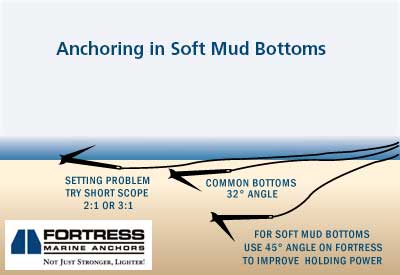
Soft Mud Bottoms
Mud can REDUCE your anchor holding power by up to 85%.
Tip: If having problems setting your anchor in mud; Shorten the scope to 2:1 ratio then increase to 5:1 and power set the anchor.
Alternative: Consider an adjustable High-Tensile aluminum-magnesium, stronger than steel, Fortress Anchor with unique, one of a kind patented 45 degree mud setting with mud palms as standard. The adjustable Fortress Anchor 45 degree mud setting can increase holding power in mud by as much as 400%.
Following some of the above anchoring standard basics could assist to help have a successful outing or save your boat.
A 21 lb (10 kg) Fortress model FX-37 was tested against ten competitive and much heavier steel anchors. Review the results here.
Fortress Anchors “The World’s Best AnchorTM” has been a dedicated partner of CPS-ECP for over a decade. Fortress, through Bill Milne Alex Milne Associates, presents the unique “Fortress Signature FX 11 Anchors (up to 32 ft) at our annual National Conferences to a hard working, disserving, training officer selected in each region.
www.fortressanchors.com and www.alexmilne.com
Follow the CPS -ECP button below for further details.