

CYOB Inbox: High water help, please
Nov 5, 2020
Hi John, you folks are involved with the Great Lakes area and I have a quick question.
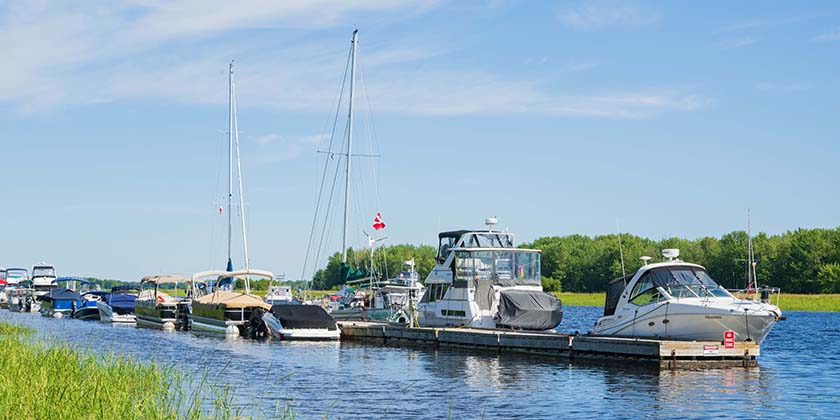
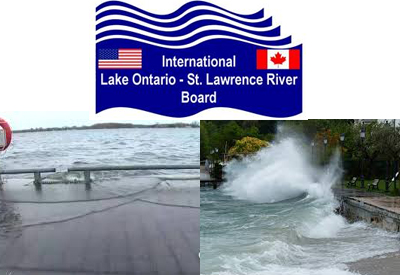
For cottage owners on larger lakes/Great Lakes there is usually a chance of large waves unless you are located in a sheltered bay with breakwater. Also water levels differ greatly from spring runoff to pre-winter lows. On my lake we can get 3 to 4ft water level change from spring to fall. What type of dock do great lakes cottage owners typically use and what is the best choice for affordable boat storage? Have seen more use of fixed docks. Seems the fixed docks have to be wider and a few sections to allow for use of boat whips as a boat bouncing in the water will rub against a fixed dock. Floating docks seem to take a beating in the weather.
Also boat railway systems seem to be used in eastern Canada on the Great Lakes to bring the boat out of the water, wave action and allows for using the boat throughout the day. Of course there are boat lifts but removing the lift at the end of the season can be a lot of work as the leg pads have sunk into the lake bottom etc. I can appreciate putting a boat on the trailer or in a sheltered marina is the best protection but if you would like to use the boat frequently at your cottage, there may be other ways of storing the boat? Any suggestions?
Cheers
Erich
—-
 Hello John
We are international award winning naval architects specializing in yacht design. For over 30 years we have been studying ways to make motoryacht more fuel efficient. Our current work is 30% more fuel efficient than most. We do more work with bow bulbs on small craft than anyone in North America. We are currently doing a 12 month research program with NRC looking at furthering our fuel efficient hull technology another 10 – 15%.
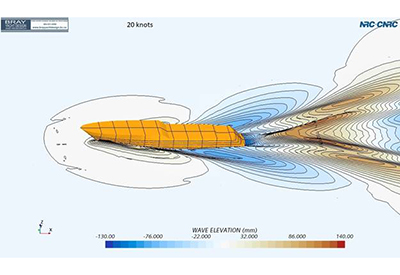
“Here is an image from the computational fluid dynamics research work that I am doing with the National Research Council of Canada’s Ocean, Coastal and River Engineering Research Centre (OCRE) on fuel efficient hull technology. This project is also supported by advisory services and research and development funding from the NRC Industrial Research Assistance Program (NRC IRAP). This is our 45m base hull at 20 knots. The significant thing about this image is the low wave profile, an indication of low hull resistance.”
Best regards,
Patrick J. Bray
Naval Architect, Eng.L.
The inbox is online
Questions or comments? Please send them along to CYonboard@kerrwil.com.