


Nelson Marek 36
 Built initially by Martin Yachts in Vancouver for IMS (International Measurement System) and ultimately for one design racing, the Nelson/Marek 36 is a design with focus. Until a fleet is established, however, racing under the IMS rule will have to be endured, as the real goal is to race identical boat against identical boat to test the talents of skippers and crews.
The design brief to the California team of Nelson/Marek was not unusual-demanding “a top performer in today’s typical windward-leeward courses.” Another decision at the outset involved the sailplan. Interestingly, they chose mast and boom dimensions that exactly match those of the Bruce Farr designed Mumm 36 — one of their chief competitors. This will allow owners of the N/M 36 to compete in “away” regattas (presumably in borrowed Mumm 36s) and to take their own set of sails with them. They are hoping that they can add a little incentive to early owners by joining in the Mumm 36 established success but at a considerably reduced cost. Ian Fraser, the dealer for the N/M 36 from Westerly Yacht Sales, considers this boat a much better value than the Mumm (but then what salesman worth his salt wouldn’t make such a claim). I’ll let you be the final judge.
These matched sailplans give us a chance to compare the design decisions of two top ranked designers — Bruce Farr and Nelson/Marek. Each has chosen a 36 foot boat, but Nelson Marek has narrowed the beam to 10 ft. 4 in., 18 in. narrower than the Farr boat. Most of that beam has come out of the topsides (the beam difference isn’t that great at the waterline), resulting in a boat that has much less flare. The America’s Cup class has followed the same trend, although I must be cautious making this comparison for the rules under which the boats sail are entirely different, with this year’s crop of A.C. hulls being significantly narrower and more slab sided. Reducing the overall beam will lower the resistance as the boat heels in the upper wind strengths — it is simply a slimmer boat and easier to push through the water. In light air the flare or no flare decision has little effect. The significance to the sailor is that the Nelson Marek will tolerate sailing upwind heeled, while the Farr boat will want to be kept more on its feet.
In an upwind boat speed contest between these two designs, it’s too difficult to predict the winner. The Nelson Marek is lighter, claiming they can build the boat 500 pounds lighter than the Mumm, and has the same keel weight poured into a larger shallower keel. The tall thin rudders are very similar. I suspect the leeways while sailing upwind will be comparable. Farr has gone with more draft (which should reduce leeway), but less area (which will increase leeway). Upwind speed will be greater on the Farr boat because of the reduced keel area, but less because of the greater boat weight. To really determine the winner, you need to push both boats through a performance prediction, or let them loose on the water – something that will happen soon I am sure.
Downwind the efficiency of the keel is not a factor, but wetted surface and sailing length are. Nelson/Marek are hoping that the lighter weight of the overall boat makes up for the extra wetted surface of the larger keel.
The hull, deck and interior are constructed of E glass (what most sailors think of as normal fiberglass) and S-glass (high strength glass) bonded with epoxy resin and vacuum bagged to eliminate entrapped air and unwanted excess resin. Foam and balsa core are used selectively with the balsa incorporated in areas with high compression loads. Indicative of the high end racing market, the rudder is carbon fibre construction.
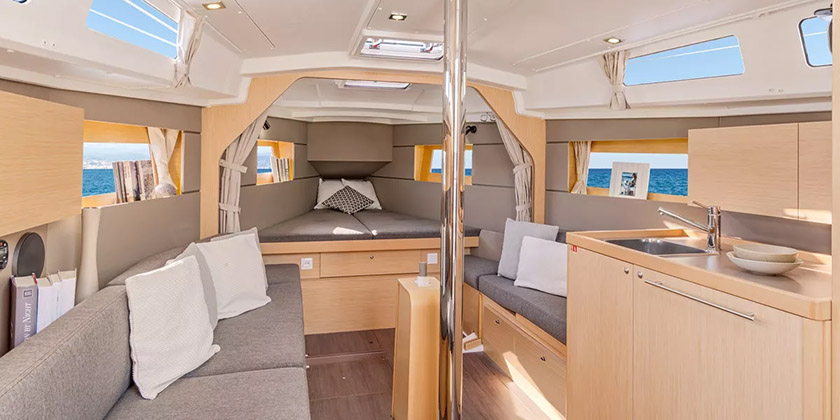
The back page of the promotional brochure for the N/M 36 is entitled “cruising comfort”. I think you don’t really want to cruise on this boat and it’s certainly not my definition of comfort. With a galley split on port and starboard, no oven, no table, no chart table, no separate cabin aft and no bureau storage, it’s not the boat for a two week holiday. It is however, the boat for evening races, weekend regattas and Key West race week. Just like other light displacement racers, it is a purpose built racer that will cut to windward like a knife and take off down wind.
Specifications
LOA 35 ft. 7 in.
Beam 10 ft. 4 in.
Draft 7 ft.
Ballast 3,500 lbs.
Weight 7,600 lbs.
Sail Area 643.5 sq. ft.
To see if this boat is available, go to http://www.boatcan.com for listings!